Combat Arts Bicep Injuries Overview
Paulo Costa, the Brazilian MMA fighter, tore a biceps tendon and had surgery on it. Reporting at the time put his layoff at the better part of a year, and he was out for most of 2019 before a booking against Israel Adesanya for the middleweight championship could be made. Treat those dates as press reporting rather than a medical record. The shape of it is right, though: a torn biceps tendon is a long road back, and how long depends on which tendon tore, whether it was repaired, and how rehab goes.
Causes of Bicep Injury
Often, injuries to the bicep are due to hand to hand combat training. When a loaded, bent elbow is forced straight against the fighter’s own contraction, the distal biceps tendon can tear off the radius — the forearm bone it attaches to. The biceps is the main supinator of the forearm, the muscle that turns the palm upward the way you would open a jar or drive a screwdriver, and it also bends the elbow.
The classic mechanism is eccentric: the arm is bent and pulling hard when an outside force straightens it. Throwing a hook that gets suddenly blocked, or having the arm pried straight in a grapple, loads the tendon while the muscle is still contracting, and the tendon can pull clean off the bone.
Symptoms of Bicep Injury

Source: Prostock-studio, Standard License, via Shutterstock
Types of Bicep Injuries
The most common injury to the biceps is the biceps tendon rupture. This could be the rupture of the proximal biceps tendon or the rupture of the distal biceps tendon. The tears could be partial or complete.
Related Bicep Injuries
Biceps Tendon Tear
The biceps tendon is composed of two heads. The long head from the scapula and the short head from the coracoid process. The tendon attaches to the radius. It acts as a strong supinator of the forearm and a weak flexor of the elbow. It also contributes to the glenohumeral joint and makes the joint stable. It is usually seen in the dominant limb.
Symptoms of Bicep Tendon Tear
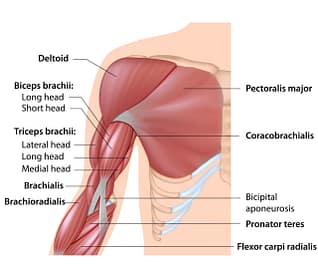
Source: Alila Medical Media, Standard License, via Shutterstock
Causes of Bicep Tendon Tear
In MMA, the rupture of the distal biceps is due to excessive eccentric force. This is more so when the arm changes to extension from flexion. Throwing jabs, hooks and armbars are all moves where this motion is common.
A rupture of the proximal biceps tendon is more often the product of repetitive load, and it travels with rotator cuff problems. Risk factors such as smoking, corticosteroid and anabolic steroid use, and overuse make a biceps tendon tear more likely. Quinolone antibiotics, diabetes, lupus and chronic kidney disease are associated with tendon rupture as well — they raise the risk, rather than tear the tendon on their own.
To learn how Biceps tendon tears is diagnosed Click Here
Common Bicep Injuries
Common bicep injuries like sprains and tendinopathies are explained further in our Common Injuries section.
Bicep Injury Diagnosis
The diagnosis of a biceps tendon tear is often clinical. If there are partial ruptures, then imaging is helpful. To diagnose the biceps tendon tear, three criteria are needed. The presence of trauma, visible signs of biceps retraction or the Popeye deformity, and the weak elbow flexion with weak supination.
Focusing on Arm Strength Can Help Prevent & Manage Bicep Injuries
Subscribe for More Advice!
Injury Specific Diagnosis
Biceps Tendon Tear
Physical Exam
On the physical exam, many fighters will display, ecchymosis, swelling, and tenderness in the antecubital fossa. The doctors will palpate the upper arm and find a defect in the distal tendon. The muscle may be retracted. The hook test can identify the absence of the biceps tendon distally.
Here the doctor will position the affected arm in 90° of flexion and then supinates the arm. Then they will hook the tendon under the skin. If the distal biceps tendon is intact it will allow the examiner to hook the index finger under the biceps tendon.
This test is very specific and sensitive to diagnose the distal biceps tear. For those with proximal tendon rupture, pain and ecchymosis extending up to the elbow is visible. However, the doctor will examine the shoulder muscles and nerves as rotator cuff pathology is common with these tears.

Source: Max kegfire, Standard License, via Shutterstock
Imaging
The best test here is the ultrasound. Ultrasound is a cheap, noninvasive way to see the absence of the tendon. Plain films are not helpful. X-rays are done to rule out other bone pathology or verify radial tuberosity hypertrophy. It can also confirm an occasional avulsion fracture of the tuberosity if present. MRI is not necessary for diagnosis. It does confirm whether the tear is complete or partial. An MRI can also confirm the degree of retraction and whether the tear is in the muscle or the tendon.
Lab Tests
Lab tests are not necessary for diagnosing biceps tendon tears. The diagnosis is mostly clinical.
To learn how Biceps tendon tears are treated Click Here.
Common Diagnoses
Biceps injuries are diagnosed clinically and occasionally require imaging. Find out more these diagnostic tests from our Common Diagnoses section.
Bicep Injury Treatment
The treatment of the biceps tendon rupture depends entirely on the type of rupture and site of rupture. Treatment is lengthy and requires a long rehabilitation program. Chronic biceps injuries that are present for longer than 4 weeks can complicate the treatment process. The biceps tendon can retract significantly if left untreated and so it needs prompt diagnosis and treatment.
Injury Specific Treatment
Biceps Tendon Tear
Emergency
Once a fighter presents to the ED, the diagnosis is made after a clinical exam. Seek orthopedic consult immediately. Distal biceps tear should see orthopedic surgeons as soon as possible. Any delay in treatment can cause the tendon to proximally retract significantly.
Medical
The treatment of a biceps tendon rupture depends on the site of the rupture. A rupture of the proximal biceps tendon, the long head, can usually be managed without surgery. Left alone it leaves some cosmetic deformity — the Popeye bulge — and intermittent biceps cramping. Fighters who want the shape and the cramping dealt with, or who are having other shoulder pathology addressed at the same time, often opt for surgery in the form of a biceps tenodesis, which cuts the tendon and reattaches it to the humerus.
Subpectoral tenodesis is one common way to do this; surgeons also fix the tendon higher up, in the suprapectoral position, and the choice comes down to surgeon preference and the rest of the shoulder findings. Using arthroscopy, implants such as interference screws and bio-absorbable suture anchors secure the tendon in place.
A complete rupture of the distal biceps tendon is usually repaired surgically in a fighter, because repair is what restores forearm supination strength, protects elbow flexion strength and settles the pain in the antecubital fossa. Managing it without surgery is an option for people with low demands on the arm, but it costs supination strength permanently. The repair can be done two ways.


The non-anatomic approach sutures the ruptured tendon to the brachialis. It is the simpler operation and it restores elbow flexion strength, but it does not restore supination — the tendon no longer pulls on the radius, so the forearm loses the muscle that turns the palm up. The anatomic approach reinserts the tendon onto the radial tuberosity where it came from, and that is the standard repair for exactly this reason: the difference in supination strength is substantial, not marginal.
Two surgical techniques exist to fix the torn distal biceps tendon. The anterior single-incision technique places one incision over the antecubital fossa at the front of the elbow; it carries a risk of injury to the lateral antebrachial cutaneous nerve. The other adds a second incision behind the elbow. Both are in current use — single-incision repair, commonly with cortical button fixation, is at least as common as the two-incision approach — and each carries its own complication profile. That is a conversation to have with the surgeon.
Home
Following surgery there are different rehabilitation protocols, and the one that applies to you is the one your surgeon writes. After a distal biceps repair at the elbow, the early limits are on elbow extension and on resisted supination: gentle active or passive elbow flexion and supination inside the surgeon’s stated range, in a sling or hinged brace, with strengthening added weeks later. A proximal repair or tenodesis at the shoulder is a different protocol built around shoulder range of motion. Do not borrow one protocol for the other injury, and do not add load ahead of the schedule you were given.
Common Treatments
Biceps injuries are treated using physical therapy, medications, and surgery. Read more about them in our Common Treatments section.