
The Greek martial arts were wrestling, boxing, pankration, and a fourth that almost nobody remembers: pammachon. The first three were Olympic events. The fourth survives in a single papyrus letter, one inscription, and a handful of later texts.
This article provides an overview and insights on all four, what the ancient evidence says about Pammachon, how it differed from Pankration, and how it is being revived in Greece today. Here is a brief overview to set the stage:
Why Did the Greeks Value Combat Sports?
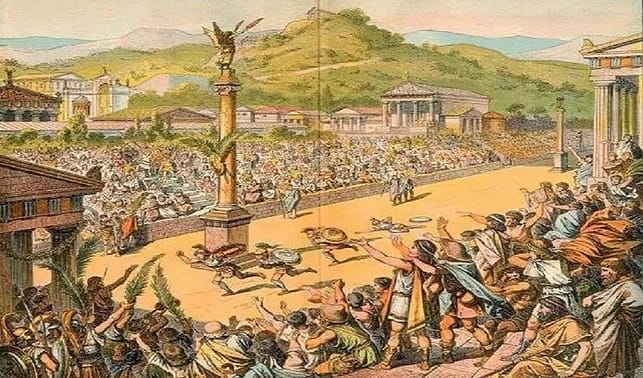
The ancient Greeks practiced combat sports that were remarkably similar to many of the fighting sports we watch today. They saw them as a way to prepare young men for adult life.
Source: Public Domain
The Greeks believed that competing taught young men what effort and fair contest could do for an organized society. For that reason, combat sports were part of life in nearly every Greek city-state. They were the natural choice for any young man who wanted to show his strength, courage, and determination.
The Olympic record shows how early that began. Only footraces predated wrestling, which was introduced in 708 BCE, and boxing made its debut as an event 20 years later.
What Are the Greek Martial Arts?
Three combat sports were contested at the ancient Olympic Games. The Greeks grouped them as the “heavy events.”
Wrestling
Three combat sports were contested at the ancient Olympic Games. The Greeks grouped them as the “heavy events.”
Wrestling being the oldest. The athletes fought with bare hands while standing up, and an athlete won after he forced his opponent’s hip, shoulder, or back to the ground three times.
Boxing
Boxers wrapped their hands and wrists in leather. There were no rounds. A boxer won when his opponent was knocked out or gave up.
Pankration
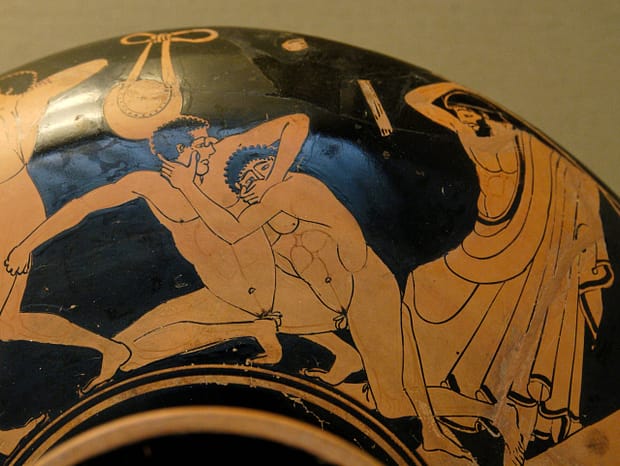
Pankration is the one modern readers know best. Britannica calls it “an ancient precursor to modern mixed martial arts.” It joined the Olympic program in 648 BCE.
Source: Marie-Lan Nguyen, Public Domain, via Wikimedia Commons
The rules were short. “Contests were savage, with hitting, kicking, twisting of limbs, strangling, and struggling on the ground allowed. The only recognized fouls were biting and gouging.” A contest ended when one fighter gave up or was knocked unconscious. Some competitors died.
If the idea of a mixed fighting sport interests you, our guide on how to learn MMA covers its modern form.
What Is Pammachon?
The word comes from the Greek pammachos. Historian Sofie Remijsen translates it as “fighting with all means,” and notes that it did not have to refer to sport. The word could describe any all-out fight, in a stadium or outside one.
In Greek, machi (μάχη) describes a combat-style confrontation between two or more people, armed or unarmed. A fair translation of pan-machon (πάν-μαχον) is “total combat.”
For centuries the word was not the name of a separate sport. Because it sounds so much like pankration, Remijsen writes, poets from the fifth century BCE used it as a synonym. The Roman author Hyginus lists Heracles as a victor in the “pammachum, quod nos pancratium vocamus”: the pammachon, which we call pankration.
That changed in late antiquity.
What Is the Evidence for Pammachon?
A Letter From Alexandria
The key document is a papyrus letter now in Berlin, known to scholars as SB 3.6222. It was first published by Wilhelm Schubart in 1918. Remijsen, then at Leuven University, re-examined it in her 2010 article “Pammachon, A New Sport.”
A young man named Dios wrote it to his sister Sophrone. He had arrived in Alexandria to find the emperor visiting. Remijsen identifies the emperor as probably Diocletian and dates the letter to about December 301 CE.
The emperor ordered athletes to be brought out to compete, and Dios was chosen. It began badly. In Remijsen’s translation, Dios writes: “I was at first paired up to do pankration and I had bad luck, as I do not know how to do pankration.”
So he changed the game. “I challenged the five to do pammachon,” he writes. He fought them one after another and came away with the prize money and a gold coin. The other five received a linen tunic.
Remijsen’s conclusion is direct: “We are, in other words, dealing with two different sports.” The letter is the earliest evidence of pammachon as a sport in its own right.
Other Ancient Sources
The letter does not stand alone. Remijsen counts ten sources in all.
The places named in these sources are Rome, Constantinople, Cyprus, Alexandria, and Gaza. By the fourth century, Remijsen concludes, the sport had spread across the eastern and central Mediterranean.
Pammachon vs Pankration: What Was the Difference?
Here the historian and the modern practitioners part ways. Both views deserve a hearing.
The Historian’s View
Remijsen reads the evidence as showing a rougher, simpler sport. Hesychius, she notes, defines it as “an unsophisticated sport practiced outside the palaistra, since the people from Cyprus wrestle untechnically.” The palaistra was the wrestling school.

Source: Rijksmuseum, CC0, via Wikimedia Commons
That fits Dios. He was strong enough to be picked to fight before an emperor, but he had not trained in pankration. Remijsen suggests that pammachon grew up as “a kind of street fighting in which everything was allowed,” in reaction to the highly technical sports of the gymnasium.
The Practitioners’ View
Kostas Dervenis, who revived the art, reads the word itself differently. For him, pankration is the sport and pammachon is the wider art of battle, with or without weapons.
His federation puts it this way: “One could say that pankration is very much a part of pammachon but not the opposite.”
The ancient sources are too few to settle the question. What both sides agree on is the central point: by 300 CE, pammachon and pankration were not the same thing.
Greek Martial Arts Compared
Art | First Recorded | What Was Allowed | How a Bout Ended |
|---|---|---|---|
Wrestling | Olympic event from 708 BCE | Standing grappling with bare hands | Three falls: hip, shoulder, or back to the ground |
Boxing | Olympic event from 688 BCE | Punches, with hands and wrists wrapped in leather | Knockout or surrender |
Pankration | Olympic event from 648 BCE | Striking, kicking, joint twisting, strangling, and ground fighting. No biting or gouging. | Surrender or unconsciousness |
Pammachon | As a separate sport, about 300 CE | Not recorded. One ancient dictionary calls it unsophisticated wrestling practiced outside the wrestling school. | Not recorded |
How Was Pammachon Revived?
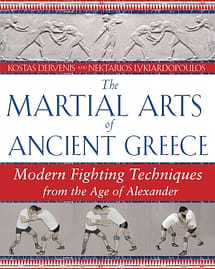
Pammachon was revived in 1999 by Kostas Dervenis. He used the name for both the martial art itself and the warrior’s path expressed through it. Dervenis is also the co-author, with Nektarios Lykiardopoulos, of The Martial Arts of Ancient Greece: Modern Fighting Techniques from the Age of Alexander (2007).
Mr. Dervenis, whom we contacted to learn more about the revival, told us that pammachon is now part of the Hellenic Federation of Pankration Athlima (ΕΟΠΑ). It is one of the arts used to prepare military and police personnel in Athens for close-quarters combat against a person who may be carrying a concealed weapon.
Today the art is promoted by the International Pammachon Federation, of which Dervenis is president. The federation says that pilot projects were carried out in Greece and the United States between 2014 and 2024 to reconstruct the sport and test its rules.
Affiliate Link
The Modern Rules of Pammachon
The modern sport simulates a close-quarters fight in which a hidden weapon may appear. These were the basic rules Mr. Dervenis gave us:
- 1Any strike to the body is acceptable. However, only one strike to the head or face is allowed when the competitors are standing per round, and one strike when they go to the ground per round.
- 2Participants shall use soft “rubber” training blades that mold to the body and bend. “Hard” plastic or metallic knives are forbidden. Rubber weapon length cannot exceed fourteen inches.
- 3Rubber blades may not be drawn until contestants enter a standing clinch, grapple, throw, or go to the ground. Rubber blades may not be used when contestants are in “boxing” or “kicking” range in the standing position. Pammachon is not a fencing match or blade duel but is intended to simulate the use of hidden weapons in close quarters combat within grappling range.
- 4A contestant’s rubber blade may not be drawn by his opponent, but may be turned against an opponent following a disarm when he has drawn the blade himself.
- 5In cases where a participant is able to draw his rubber knife, or take his opponent’s weapon or turn the opponent’s weapon against him and successfully strike once at designated fatal targets, the fight is considered a TKO win in his favor. Fatal targets requiring only one strike with the rubber weapon are the neck, clavicle, torso centerline immediately below the sternum, lower abdomen centerline, kidney region, and groin area.
- 6Any weapon that has fallen to the ground may be used by any contestant.
- 7The head and face may not be struck with the rubber knife at any time, and such violation is cause for immediate disqualification.
Where Can You Train in Pammachon Today?
The International Pammachon Federation (IPF) historically provided all training and certification for instructors and athletes. When this article was first written, the IPF was overseeing just five certified training facilities in all of Greece, with A.S. Pammachon in Athens being one of the best known for focusing almost exclusively on this art. Today, the IPF remains highly active and functions as the global governing body for the sport. Rather than disappearing, it has transitioned from conducting early validation pilots to establishing official, state-recognized structures around the world.
As part of this transition, those domestic responsibilities were turned over to the Hellenic Pammachon Federation (Ελληνική Φίλαθλος Ομοσπονδία Παμμάχου, or ΕΦΟΠ) in 2026. This newly established national body now comprises 23 certified athletic clubs across Greece that oversee the promotion and training of Pammachon.
Within these 23 certified facilities, the training focus is evenly split. Instructors divide their curriculum between traditional Pammachon, which preserves the historical martial art, and sport Pammachon, which adapts the style into a modern combat sport.
For other fighting arts that were lost and found again, read our articles on Irish stick fighting and Bartitsu.

Frequently Asked Questions
What Are the Greek Martial Arts?
The ancient Greek martial arts were wrestling, boxing, and pankration, which were all Olympic events, and pammachon. Wrestling joined the Olympic Games in 708 BCE, boxing in 688 BCE, and pankration in 648 BCE. Pammachon appears as a separate sport in sources from about 300 CE.
What Does Pammachon Mean?
Pammachon means “total fight” or “total combat.” It comes from the Greek words for “all” and “battle.” Historian Sofie Remijsen translates the root word as “fighting with all means.” Ancient poets first used it as another name for pankration.
Is Pammachon the Same as Pankration?
No, not by about 300 CE. In a letter from Alexandria, an athlete named Dios says he did not know how to do pankration, so he challenged his rivals to pammachon instead. A later inscription lists pammachon, wrestling, pankration, and boxing as four different events.
Can You Learn Pammachon Today?
Yes. Kostas Dervenis revived pammachon in Greece in 1999 as a modern martial art. The International Pammachon Federation, which he leads, trains and certifies instructors and athletes. The modern sport uses soft rubber training blades at grappling range.
