Martial arts techniques represent the culmination of centuries of combat wisdom, with kicks standing as perhaps the most visually impressive and tactically diverse weapons in a fighter's arsenal. Throughout my journey in traditional martial arts and exposure to various fighting systems, I've come to appreciate how mastering different types of kicks in martial arts can transform both offensive capabilities and overall movement quality.
Kicks develop extraordinary balance, flexibility, and body awareness that benefit practitioners in all aspects of life. From the powerful roundhouse kicks of Muay Thai to the precise side kicks of Karate to the flashy spinning techniques of Taekwondo, each style emphasizes particular kicking mechanics that reflect its fighting philosophy.
In this guide, I'll break down the essential types of kicks found across martial arts disciplines, from fundamental techniques suitable for beginners to advanced movements reserved for experienced practitioners. Whether you're looking to expand your technical repertoire or deepen your understanding of kicks you already practice, this guide will serve as a valuable resource for your martial arts journey.
Types of Kicks in Martial Arts at a Glance
Before we break each one down, here is a quick map of the kicks covered in this guide, the arts they are most associated with, and what they are best used for. Use it as a reference you can return to as your training progresses.
Kick | A.k.a. | Primary Use | Level |
|---|---|---|---|
Front / Push | Mae Geri, Teep | Distance control, stopping forward pressure | Basic |
Roundhouse | Mawashi Geri / Dollyo Chagi | All-purpose power strike | Basic |
Side | Yoko Geri | Long-range linear power | Basic |
Low | Thigh kick | Compromises the base and mobility | Basic |
Hook | Ura Mawashi Geri | Curving around a guard | Intermediate |
Axe | Kakato Geri | Downward strike over a guard | Intermediate |
Spinning Back | Ushiro Geri | Rotational counter power | Intermediate |
Crescent | In / outside crescent | Clearing guards, disarming | Intermediate |
Calf | Low-line roundhouse | Attacking the peroneal nerve and mobility | Modern MMA Staple |
Cut | Inside leg kick | Disrupting stance and balance | Modern MMA Staple |
Tornado |
360 degree roundhouse |
Demonstration, unexpected angles |
Advanced |
Jump Side |
Flying Side kick |
Height, bypasses low defense |
Advanced |
Basic Kicks (Beginner Level)
The foundation of any martial artist's kicking arsenal begins with mastering basic kicks. These fundamental techniques may appear simple, but they contain all the core principles that more advanced kicks build upon. Basic types of kicks offer several advantages: they're easier to execute under pressure, require less setup time, and typically expose you to less counter-attack risk.
Push Kick - Front Thrust Kick (Mae Geri/Teep)
The front thrust kick, known as Mae Geri in Karate or Teep in Muay Thai, is often the first kick taught to beginners. This straight-line kick delivers force directly forward, making it both easy to understand conceptually and highly effective in application.
The mechanics involve:
What many beginners don't realize is that the front kick is not solely an attacking technique. In Muay Thai, the teep functions primarily as a distance management tool—creating space, disrupting an opponent's forward momentum, or setting up other attacks.
I've found that developing a strong front kick requires particular attention to hip flexibility and core strength. When I watched training sessions, the insight I took away from those experiences was that they focused extensively on proper chamber position before attempting full extension.
Roundhouse Kick (Mawashi Geri/Dollyo Chagi)
The roundhouse kick is arguably the most versatile and widely used of all martial arts kicks, appearing in nearly every striking art with variations in execution. This kick delivers tremendous power through its circular motion, utilizing the rotation of the hips to generate force.
A biomechanical study of expert Muay Thai, Karate, and Taekwondo practitioners found that effective roundhouse power comes from rapid forward rotation of the pelvis combined with hip and knee extension, with the speed of the foot at impact driving the force delivered.
Key technical elements include:
What distinguishes different styles' approaches to the roundhouse kick is primarily the striking surface and body mechanics. In Muay Thai, practitioners typically strike with the lower shin, while Taekwondo emphasizes speed with a snapping motion, often targeting with the instep for point scoring in competition.
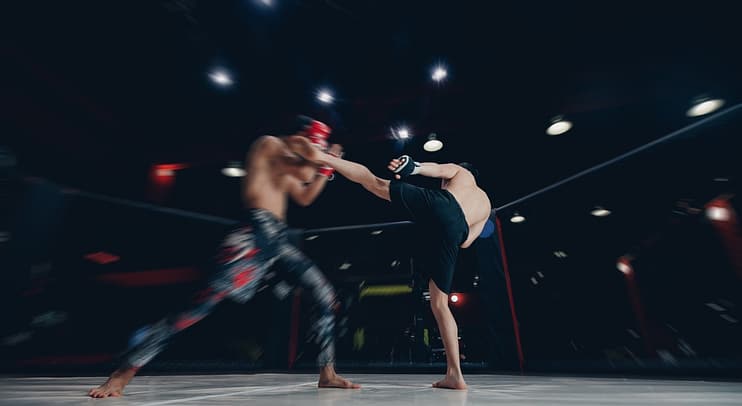
Source: Parilov via Shutterstock
Side Kick (Yoko Geri)
The side kick delivers force laterally from the body, using the heel or edge of the foot as the striking surface. This kick excels at maintaining distance and can generate exceptional power when properly executed.
The technique involves:
The side kick is deceptively complex despite its straightforward appearance. I often use the analogy of a door hinge: your hips are the hinge, and your leg is the door, swinging directly outward without curving.
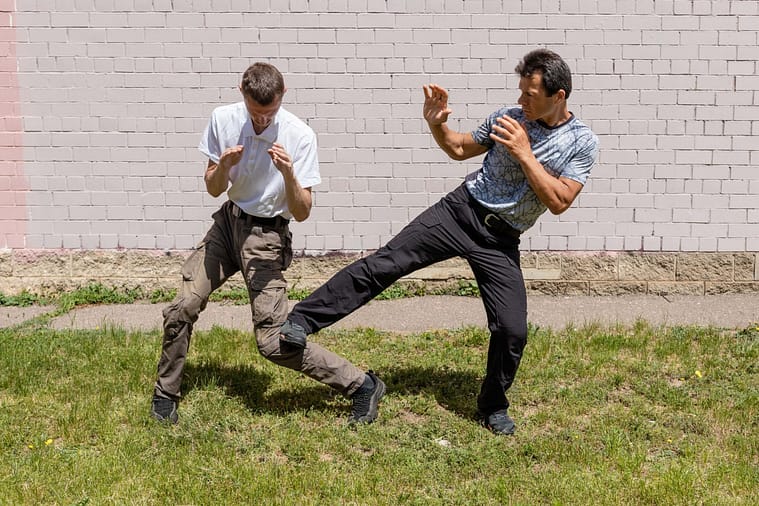
Source: Volha Werasen via Shutterstock
Low Kick
The low kick targets the opponent's legs, typically the thigh or calf, and serves as a foundational technique in many combat sports. Though simple in execution, low kicks can dramatically impact a fight by compromising an opponent's mobility and stance.
Effective low kick technique includes:
What makes low kicks particularly effective is their relatively low risk and high reward. They're harder for opponents to catch or counter than higher kicks, yet can accumulate significant damage over the course of a fight.
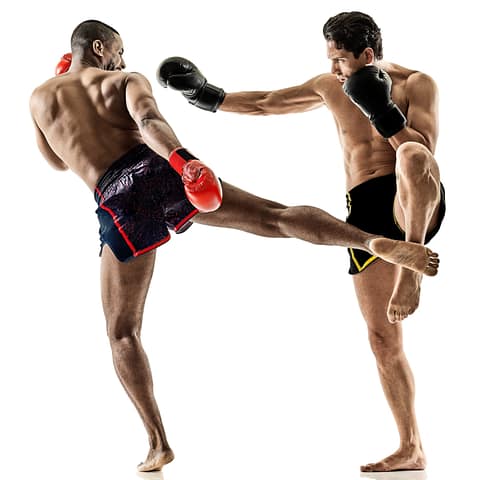
Source: OSTILL is Franck Camhi via Shutterstock
Intermediate Kicks (For Developing Skill & Power)
As practitioners progress in their martial arts journey, intermediate kicks offer new tactical options and greater technical challenges. These different types of kicking techniques build upon the foundation established through basic kicks, adding elements of misdirection, increased power generation, or expanded targeting options.
Hook Kick (Ura Mawashi Geri)
The hook kick follows a deceptive curved path that makes it difficult to detect and defend against. Unlike more linear kicks, the hook kick initially appears to be traveling in one direction before changing course to strike from an unexpected angle.
The execution involves:
What makes the hook kick particularly effective is its ability to navigate around guards and blocks. My takeaway and aspect you should focus on for this kick is the importance of hip position and flexibility. Without proper hip rotation and opening, the kick loses its power and becomes merely a tapping motion rather than a damaging strike.
Axe Kick (Kakato Geri)
The axe kick is one of the most distinctive types of martial arts kicks, delivering force downward upon an opponent. This kick follows a high upward path before descending sharply onto the target, similar to the motion of swinging an axe.
Proper execution includes:
The axe kick requires exceptional hamstring flexibility and core strength. One training insight I believe should be practiced is focusing on is building muscle memory on the chambered position at the top of the kick, holding that position for a three count before attempting the downward strike.
Spinning Back Kick (Ushiro Geri)
The spinning back kick combines rotational force with linear power, creating one of the most powerful techniques in martial arts. This kick requires turning away from your opponent—seemingly a vulnerable movement—before delivering devastating force through the heel.
The technique consists of:
Many practitioners struggle with maintaining balance during the spin and generating power through proper body alignment. Developing a strong awareness of center and rotational movement will significantly enhance spinning techniques.
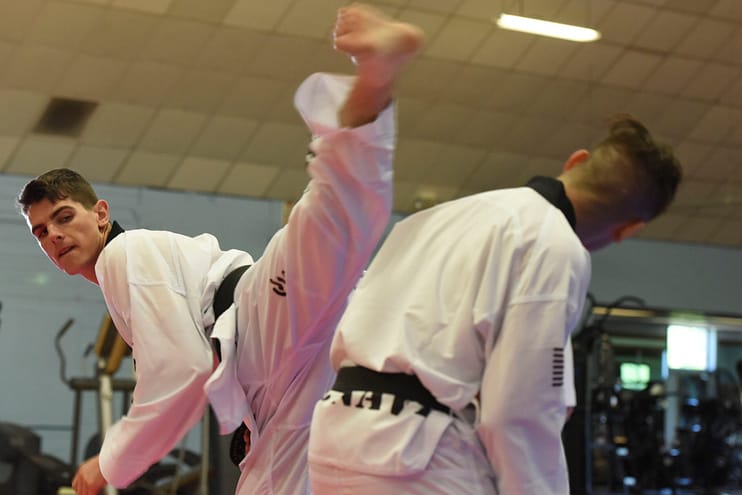
Source: Tech. Sgt. Erich B. Smith via DVIDS
Crescent Kick
The crescent kick follows a curved path that resembles a half-moon or crescent shape. This technique exists in two primary variations: the inside crescent (moving from outside to inside) and the outside crescent (moving from inside to outside).
The basic mechanics include:
While often considered more of a demonstrative technique in modern training, the crescent kick has practical applications for clearing an opponent's arms away from their guard or setting up follow-up techniques.
Advanced & Spectacular Kicks (For Experienced Martial Artists)
Advanced kicks represent the pinnacle of kicking technique, combining complex movement patterns, precise timing, and exceptional physical attributes. These spectacular types of kicks often appear in demonstrations, movies, and high-level competitions, captivating audiences with their athletic demands and visual impact.
Tornado Kick (360 Roundhouse Kick)
The tornado kick combines rotation with a jumping roundhouse kick, creating a dynamic technique that can strike from unexpected angles.
The execution involves:
The tornado kick's effectiveness comes from its deceptive entry and the momentum generated through rotation. In my observation, successful execution requires strong core stabilization and excellent proprioception (awareness of body position).
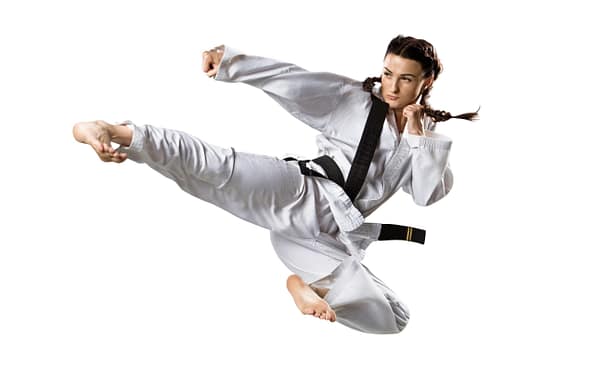
Jump Side Kick
The jumping side kick elevates the traditional side kick by adding height and momentum through a jump. This aerial technique can bypass lower defenses and strike at higher targets with increased power.
What separates an impressive jumping side kick from an average one lies primarily in the takeoff and body position during flight. If you watch training sessions, you will notice that practitioners' power comes not from simply jumping higher, but from proper compression of the kicking leg before extension and maintaining correct body alignment throughout the technique.
Source: Eugene Onischenko via Shutterstock
Modern MMA Kicks
Calf Kick
Returning to more combat-applicable techniques, the calf kick has gained prominence in modern MMA as a highly effective low-line attack. Targeting the lateral aspect of the calf muscle, this kick can compromise an opponent's mobility and balance with minimal risk to the attacker.
The effectiveness of the calf kick comes from attacking a vulnerable target that many fighters haven't conditioned to absorb impact. This battle-tested tactic is a relatively simple technique that can dramatically alter a fight's dynamics when applied strategically.
Cut Kick
The cut kick is a specialized technique that attacks the inside of an opponent's leg, often targeting the thigh or knee area. This kick "cuts" across the opponent's stance, potentially compromising their structure.
What makes the cut kick particularly effective is how it can disrupt an opponent's balance and stance. During sparring sessions, I've found this kick especially useful against opponents who maintain a wide, stable stance—the cut kick exploits their commitment to that position.
Training Tips for Improving Kicking Techniques
Developing effective martial arts kicks requires more than just practicing the motions—it demands a comprehensive approach to training that addresses all aspects of kicking performance.
Balance and Stance
Balance forms the foundation of all effective kicking. Without stability, even technically perfect kicks lack power and leave you vulnerable to counterattacks.
A simple diagnostic I use: if you couldn't immediately execute another technique after your kick, your balance was compromised. Practice maintaining a stable fighting position throughout the entire kicking sequence, including the moment immediately following retraction.
Flexibility and Mobility
Flexibility limitations represent one of the most common barriers to kicking progress. However, static stretching alone is insufficient for developing functional kicking flexibility.
For practitioners struggling with roundhouse kick height, I recommend focusing on hip flexor and adductor mobility rather than hamstring flexibility. The ability to externally rotate the hip while maintaining pelvic alignment often provides the key to unlocking higher kicks.

Bill "Superfoot" Wallace
"Flexibility isn't about kicking high. It's about being able to move your body the way you want, when you want."
Undefeated full-contact kickboxing champion, on the Superfoot System's approach to kicking mechanics (World Martial Arts Media, 2026)
That framing matches what I've seen on the mat. The practitioners with the most usable kicks are rarely the ones who can drop into a cold split. They're the ones who can put a foot exactly where they want it, on balance, and bring it back without falling into the technique.
Strength Training
Contrary to some traditional approaches, appropriate strength training significantly enhances kicking performance. The key is selecting exercises that transfer directly to kicking mechanics.
During my cross-training experiences, I noticed significant improvements in my kicking power after incorporating targeted strength work. Particularly effective were exercises that mimicked specific kicking patterns under resistance, such as cable kick-throughs and banded kick extensions.
Technical Practice
Technical practice remains the cornerstone of kick development, with shadow kicking and bag work forming the primary methods for refinement.
When practicing kicking techniques, you should emphasize quality over quantity, particularly in the early stages of learning. Five perfectly executed kicks teach your nervous system more effectively than fifty sloppy repetitions. Once proper form is established, volume can gradually increase to develop endurance and consistency.
Common Mistakes & How to Avoid Them
Even experienced martial artists can develop habitual errors in their kicking techniques. Understanding these errors—and their corrections—can dramatically accelerate your progress with all types of kicks in martial arts.
Overextension and Loss of Balance
Perhaps the most prevalent error in kicking technique is overextension—reaching beyond your current capabilities of balance and control. This typically manifests as leaning excessively, compromising posture, or falling forward after kick execution.
In my observation, most students struggle with balance issues, temporarily reducing kicking height by 20-30% to establish proper mechanics before gradually returning to full range will build the necessary foundation for balanced execution rather than reinforcing compensatory patterns.
Lack of Chambering
Proper chambering—the preparatory position before kick extension—creates both power and deception. Many practitioners either skip this phase entirely or execute it incompletely, resulting in telegraphed and underpowered kicks.

Remember that chambering serves multiple tactical purposes: it loads potential energy for power generation, conceals your intended target until the last moment, and positions your body mechanics for optimal force delivery.
Poor Hip Rotation
Hip rotation generates the majority of power in most types of kicks, yet many practitioners rely excessively on leg strength while underutilizing hip mechanics. This error manifests as "pushing" kicks rather than whipping or snapping techniques with full-body integration.
For practitioners with a background in linear striking arts, the concept of generating power through rotation can feel counterintuitive. I often use the analogy of a whip—the handle moves a short distance while generating tremendous speed at the tip through sequential energy transfer.
Improper Setup in Combinations
Technical execution represents only part of effective kicking. Many practitioners perform excellent isolated kicks but fail to set them up properly in combinations or fighting scenarios.
Kicks rarely succeed as isolated techniques in combat situations. Instead, they should be thought of as elements within broader tactical exchanges. Practicing kicks exclusively in isolation creates a significant disconnect between training and application.
Which Martial Art Has the Best Kicks?
Ask ten practitioners which art kicks best and you will get ten answers, usually shaped by whichever one they trained. A more useful question is what each art optimizes for, because "best" depends entirely on the job you need the kick to do.
Taekwondo — Speed, Height, and Variety
Ask ten practitioners which art kicks best and you will get ten answers, usually shaped by whichever one they trained. A more useful question is what each art optimizes for, because "best" depends entirely on the job you need the kick to do.
Muay Thai — Power and Durability
No art devotes more of its curriculum to kicking than Taekwondo. Its emphasis on fast, high, and spinning techniques produces the widest kicking vocabulary and the quickest delivery. If your goal is range, agility, and the spectacular end of the spectrum, this is the deep end of the pool.
Karate — Precision and Timing
Traditional Karate prizes the clean, committed technique landed at exactly the right moment. Its front and side kicks are built around distance and timing rather than volume, and that economy is why so many other striking arts borrowed from it.
Savate and Sanda — The Tactical Blends
French Savate and Chinese Sanda round out the picture, each pairing sharp kicking with their own tactical priorities. The honest answer to the "best" question is that the strongest kickers I have watched borrowed across styles rather than staying loyal to one.
The honest answer to the "best" question is that the strongest kickers I have watched borrowed across styles rather than staying loyal to one. If you are still deciding where to start, our guide to choosing the right martial art for your goals walks through how to match a style to what you want out of training.
Final Thoughts
The journey to mastering various types of kicks in martial arts extends far beyond technical knowledge. Having spent decades exploring different kicking systems, I've come to appreciate that true proficiency emerges from the integration of physical attributes, technical precision, and tactical application.
What continues to fascinate me about martial arts kicks is their dual nature—simultaneously practical combat tools and artistic expressions of human movement potential. The same roundhouse kick that can end a fight can also demonstrate beauty, control, and athletic refinement when performed in a demonstration context.
Remember that different types of martial arts kicks serve different purposes. The spectacular spinning and jumping techniques might captivate audiences, but the humble front kick or low roundhouse often proves more valuable in combat applications. Develop a full spectrum of kicking tools, understanding the appropriate context for each.
Whether your goal is competition success, self-defense capability, or personal development, the journey of mastering various types of kicks offers rich rewards. Approach the process with patience, consistency, and intelligent training methodology, and you'll develop not just impressive techniques, but a deeper understanding of movement, combat, and your own capabilities.

Frequently Asked Questions
What is the most powerful kick in martial arts?
By raw force, rotational kicks like the spinning back kick and the Muay Thai roundhouse generate the most power, because they add the mass of a turning body to the strike. Biomechanics research points to hip and pelvic rotation, not leg strength, as the main driver of kicking force. The "most powerful" kick in practice is the one you can land cleanly on balance, since a technically perfect kick that misses does no damage.
What kicks are best for beginners?
The front push kick, the roundhouse, and the basic low kick are the standard starting set. They are simple to understand, quick to throw, and expose you to less counter-attack risk than spinning or jumping techniques. Master these four before spending time on the flashier kicks, because every advanced technique builds on their fundamentals.
Why has the calf kick become so common in MMA?
The calf kick targets the peroneal nerve just below the knee, where less muscle shields it than on the thigh. That means it can rapidly compromise an opponent's mobility rather than requiring the slow damage accumulation of a thigh kick. It moved from a Muay Thai footnote to an MMA staple around 2019 to 2021 once fighters saw how efficiently it broke down a base.
Which martial art teaches the most kicks?
Taekwondo devotes more of its curriculum to kicking than any other major art, producing the widest range of fast, high, and spinning techniques. Muay Thai teaches fewer kicks but drills them to devastating effect. The best kickers often cross-train, borrowing the variety of one art and the power principles of another
How long does it take to learn a spinning or jumping kick?
Most practitioners can throw a recognizable spinning back kick or jump kick within a few months, but landing one reliably against a resisting opponent takes far longer. The limiting factor is rarely flexibility; it is balance and the ability to recover position after the technique. Build the basic kicks first, then layer rotation and elevation onto that foundation.
Featured Image Source: Cassiano Correia via Shutterstock