Every martial art claims it works. Very few prove it nightly, at full resistance, against someone genuinely trying to win. Brazilian jiu jitsu does, which is how a family art from Rio de Janeiro became the fastest-growing grappling sport in the world.
I have spent four decades in the martial arts. My start came in Isshin Ryu Karate as a teenager, then devoted most of my adult life to Aikido, training on Guam and later teaching as a staff instructor at Old City Aikido in Philadelphia. BJJ entered my life from two directions: seminars I attended over the years to round out my own grappling, and a year of sitting matside while my two daughters trained it. I am not a BJJ black belt, and I will not pretend to be one. What I can offer is a lifelong martial artist's honest read on the art, plus everything a beginner actually needs to know before stepping on the mat.
I have spent four decades in the martial arts. My start came in Isshin Ryu Karate as a teenager, then devoted most of my adult life to Aikido, training on Guam and later teaching as a staff instructor at Old City Aikido in Philadelphia. BJJ entered my life from two directions: seminars I attended over the years to round out my own grappling, and a year of sitting matside while my two daughters trained it. I am not a BJJ black belt, and I will not pretend to be one. What I can offer is a lifelong martial artist's honest read on the art, plus everything a beginner actually needs to know before stepping on the mat.
Here is the analogy from my own tradition. Aikido taught me that leverage beats muscle when you blend with force instead of opposing it. Jiu jitsu takes the same principle, drags it to the ground, and pressure-tests it until only what works survives. This guide covers what BJJ is, where it came from, the belts, the core positions and submissions, gi versus no-gi, and exactly how to start. If you are still comparing styles, my rundown of the hardest martial arts to learn and our guide to the types of martial arts pair well with this page.
What Is Brazilian Jiu-Jitsu?
Brazilian jiu jitsu (BJJ, often written "jiu jitsu" or "jiu-jitsu") is a submission grappling art that developed in Brazil from Japanese judo. Textbooks say it focuses on ground fighting, positional control, and submission holds. True, but incomplete.
After forty years around fighting arts, here is my definition. BJJ is a continuous argument about position, settled by leverage, where the loser concedes by tapping. Nobody judges your form. No referee awards you a point for looking sharp. You either control the other person or you do not, and everyone in the room knows which.
Three things separate BJJ from most other martial arts a beginner might try:
It is almost entirely ground-based. Judo and wrestling reward the throw or the takedown itself. BJJ treats the takedown as the start of the match, not the end. The real work is what happens after both people are on the mat.
Every class ends with live sparring. BJJ practitioners call it "rolling." From your first weeks you will be grappling at full resistance against training partners who are trying to submit you. That constant live testing is why BJJ techniques tend to be practical: anything that does not work against a resisting partner gets weeded out quickly.
Submissions end the fight. Instead of points for a clean strike, the decisive moment in BJJ is when one person applies a joint lock or a choke and the other taps the mat (or their partner) to signal surrender. Tapping is not a loss of face. It is the safety mechanism that lets people train at full intensity without injuring each other.
You will also hear "Gracie jiu-jitsu" (the family's self-defense curriculum) and "sport jiu-jitsu" (the competition game under rule sets like the IBJJF's). Most academies teach a blend. Understanding that split requires the history, so let us go back to a Japanese judoka who got on a boat.
History and Origins: The Gracie Lineage
BJJ begins with Mitsuyo Maeda. Maeda trained at the Kodokan under Jigoro Kano, judo's founder, then spent years abroad fighting challenge matches before settling in Brazil in the mid-1910s. In Belém, Maeda taught a teenager named Carlos Gracie, whose father Gastão had helped Maeda with local business connections.
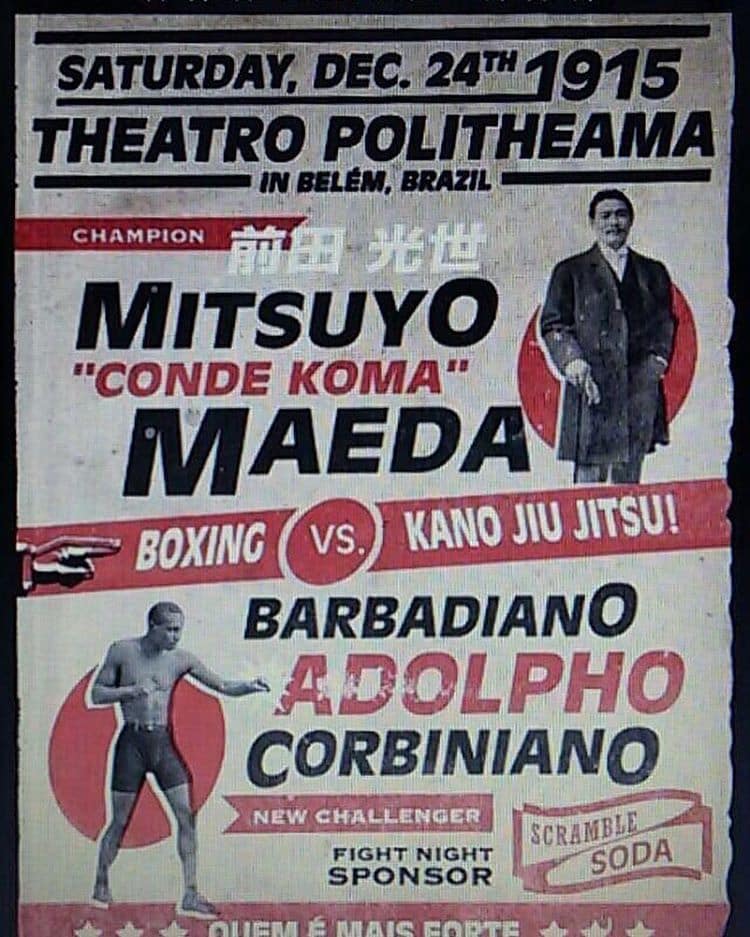
Source: Theatro Politheama (Life time: 1905), Public domain, via Wikimedia Commons
Carlos taught his brothers, and the family opened its academy in Rio de Janeiro in 1925. The youngest brother, Hélio Gracie, gets the credit for the leverage-first adaptations that define the art today. Hélio was small and frail as a young man. Family history holds that he refined techniques so a weaker person could apply them. Historians debate the specifics, but nobody debates the result: an art built around mechanics rather than muscle.
Two more lineage facts worth knowing:
The Gracies were not the only line. Maeda also taught Luiz França, whose student Oswaldo Fadda built a large following in Rio's working-class suburbs and produced his own line of black belts. Many modern academies trace back to Fadda rather than to the Gracie family.
The art was tested publicly. For decades the Gracies issued open challenges and fought vale tudo (anything goes) bouts against boxers, wrestlers, and other stylists.
That challenge culture eventually crossed into my living room. On November 12, 1993, I watched UFC 1 come out of McNichols Sports Arena in Denver, in my home state. Rorion Gracie helped create the event, and his younger brother Royce, the smallest man in the field, submitted three larger opponents in one night. Years into traditional arts myself, I remember exactly what that broadcast did to every argument about what really works. BJJ academies fill strip malls across America because of that single evening.
The International Brazilian Jiu-Jitsu Federation (IBJJF) followed in 1994, founded by Carlos Gracie Jr. It now runs the world championships and publishes the belt system most academies follow, which brings us to the question every beginner asks first.
The BJJ Belt System
BJJ promotions are famously slow, and the reputation is deserved. The IBJJF's General Graduation System sets minimum ages and minimum time at each rank. Academies can go slower. They cannot register a promotion sooner.
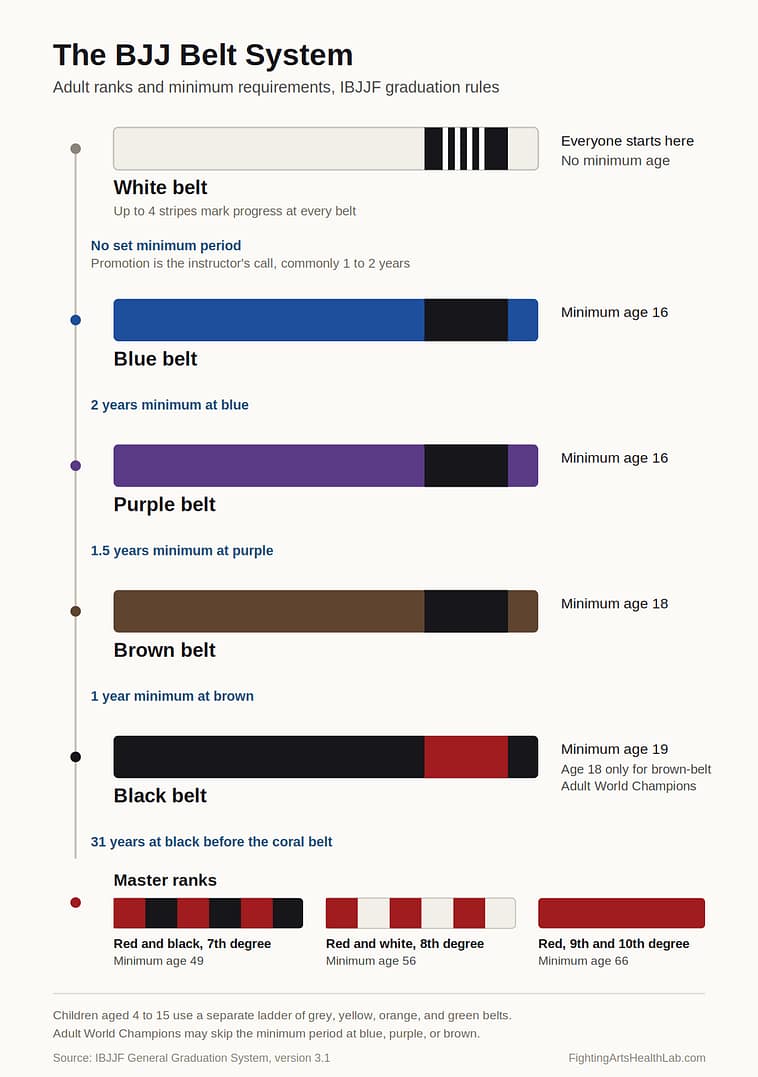
Adult belt progression under IBJJF graduation rules. Source: IBJJF.
Stripes
Between belts, most academies award up to four stripes on the belt to mark progress. Stripes are an academy-level signal, not an IBJJF registration event.
Kids' Belts
Children aged 4 to 15 use a separate ladder: white, then grey, yellow, orange, and green groups, each with a white-striped and black-striped variant. A child who reaches 16 moves onto the adult ladder at a rank determined by their kids' belt.
How long does it take to get a Black Belt?
Add the minimums and you get four and a half years from blue at the absolute floor. Reality runs eight to twelve years for someone training two to four times a week, and a blue belt alone commonly takes one to two. The timeline surprises beginners more than anything else, including the choking.
Your instructor decides promotions, not a formal test in most academies. Demonstrated skill in rolling, consistent attendance, and technical understanding earn the next belt. What you demonstrate that skill with is position, which deserves its own section.
Fundamental Positions
BJJ makes the most sense understood as a hierarchy of positions. Competition scoring and training safety follow the same logic: some positions give you control and options, others leave you defending.
I learned this the humbling way. At one seminar years ago, a purple belt giving up forty pounds calmly advanced from my guard to side control to mount while I burned energy accomplishing nothing. Decades of standing art experience meant little on the ground until I learned the map:
Guard. The defining BJJ position. You are on your back or seated, and your legs are between you and your opponent, controlling their posture and distance. Guard is the position that lets a person on the bottom attack. The main variants a beginner meets are closed guard (ankles crossed behind the opponent's back), open guard (legs uncrossed, using feet and grips to manage distance), and half guard (one of the opponent's legs trapped between yours).
Side control. Your opponent is on their back and you are chest-to-chest across their torso, perpendicular to them, with your weight pinning them. A staple top position for beginners because it is stable and easy to hold.
Mount. You sit astride your opponent's torso with your knees on the mat. In IBJJF scoring, mount is worth four points, the highest position score, because it leaves the bottom person very few good options.
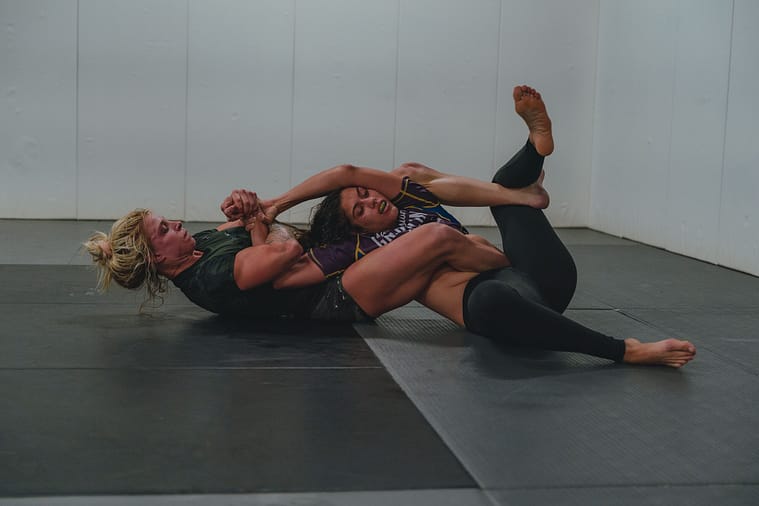
Source: Duren Williams via Pexels
Back control. You are behind your opponent with your feet hooked inside their thighs ("hooks") and your arms around their upper body. Also four points. The back is the most dominant position in BJJ because your opponent cannot see or easily attack you, and the rear naked choke lives here.
Knee on belly. A transitional top position with your shin across the opponent's abdomen. Two points, and uncomfortable enough that it tends to make the bottom person move, which creates openings.
North-south and turtle. A head-to-head pin, and the curled defensive posture on hands and knees.
Under IBJJF rules, a guard pass scores three points, a takedown or sweep scores two, knee on belly scores two, and mount or back control scores four. Classes drill the sequence those numbers imply: pass, stabilize, advance. Once you can hold a position, you earn the right to finish from it.
Common Submissions
Submissions end a BJJ match decisively. They come in two families: joint locks, which threaten to hyperextend or over-rotate a joint, and chokes, which restrict blood flow or air. The moment you feel either working, you tap.
Coming from Aikido, where wrist and elbow locks are applied with a compliant partner mid-throw, the BJJ versions felt like meeting the same ideas with the politeness removed. The mechanics rhyme. What differs is the resistance.
The submissions almost every beginner learns first:
Rear naked choke. A blood choke applied from back control, with your forearm across the front of the opponent's neck and your other arm locking it in. The highest-percentage finish in the sport.
Armbar (juji-gatame). You isolate one arm, control it with your legs across the opponent's chest, and extend it against the elbow. Applied from guard, mount, or the back.
Triangle choke. From guard, you trap the opponent's head and one arm between your legs and close the figure-four with your legs, using their own shoulder to complete the choke.
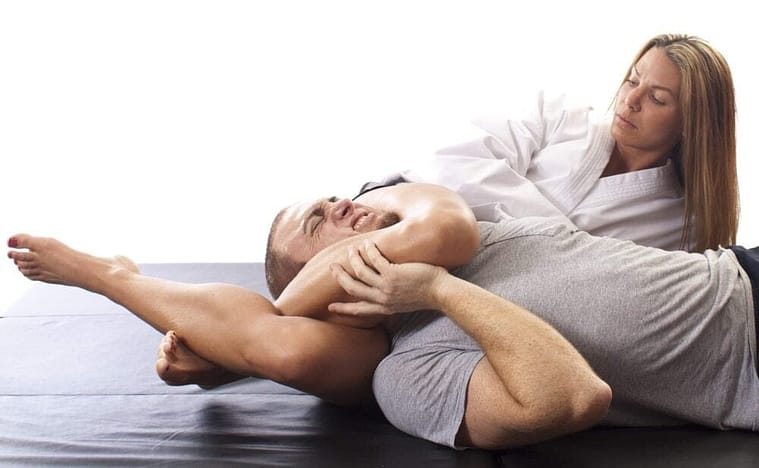
Source: G-Force Vision, Standard License, via Shutterstock
Kimura and americana. Rotational shoulder locks, threaded with your own wrist as the lever.
Guillotine. A front headlock choke, often caught when an opponent shoots for a takedown or drops their head.
Straight ankle lock. The first leg lock beginners are allowed to use in most rule sets, applied to the Achilles and ankle.
Saulo Ribeiro, a five-time bjj world champion, put the goal of all this drilling in one line in his book Jiu-Jitsu University:
The line famously continues through tiring and, in Saulo's telling, dying. His point: submissions and escapes must become reflex, because thinking speed loses to trained speed.
Now the safety data, because I promised honesty. Published competition research has repeatedly found the elbow to be the joint most often injured in BJJ, with the armbar as the most common mechanism. Scoggin and colleagues, reviewing eight Hawaiian tournaments in the Orthopaedic Journal of Sports Medicine, recorded 46 injuries across 5,022 match participations, 78 percent orthopaedic, and named the armbar specifically. Tap early. Your ego heals faster than the joint, and our guide to elbow injuries in combat sports explains what happens when people hold out.
One rules note: heel hooks and knee reaping are banned in IBJJF gi competition at every belt, and allowed in no-gi only for adult brown and black belts. Other organizations differ, so ask before using one and check the current rulebook before competing.
Gi vs No-Gi
BJJ trains in two formats, and most academies run both.
Gi jiu jitsu uses the heavy cotton uniform and belt. The gi is not a costume; it is part of the game. You grip sleeves, collars, and pant legs, and many chokes use the lapel itself. Gi grappling runs slower and more methodical because grips give both people control.
No-gi jiu jitsu uses a rash guard and shorts. With no fabric to hold, grips move to the wrist, neck, and hips, and the pace jumps. No-gi resembles what you see in MMA. If the UFC brought you here, no-gi will feel familiar, and our breakdown of MMA moves shows how grappling fits the cage.
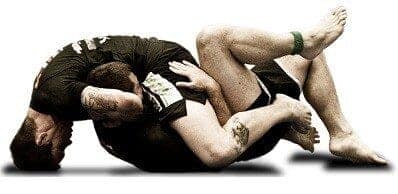
Which should you start with? My honest answer: whichever your academy runs more often, because attendance beats format. Given a genuine choice, I point beginners toward the gi. Its slower pace is kinder while you learn, and grips let you slow a stronger partner down. My daughters trained in the gi, and the nightly uniform-washing ritual taught its own discipline.
Fair warning from my seminar experience: gi grips cook your hands, and my forearms ached for days after my first afternoon of collar gripping. If your fingers complain after a few weeks, our page on finger injuries explains what is happening. The gi question usually leads straight to the bigger one: does any of this work outside the academy?
BJJ for Self-Defense
The original Gracie case was simple. Most real fights end in a clinch or on the ground, and a person trained to control that range can neutralize a larger, untrained attacker without throwing a punch. Decades of challenge matches, and then UFC 1, made the argument in public.
Having taught a defensive art myself, I will give you the assessment I give friends who ask:
What BJJ trains superbly: staying calm under physical pressure, controlling someone trying to overpower you, escaping from underneath a heavier person, and ending a confrontation with a choke or lock rather than a beating. No other widely available art pressure-tests all of this at full resistance in every single class.
What it does not train: striking, multiple attackers, and weapons. Sport-focused academies also spend little time on the older standing self-defense curriculum. If self-defense drives you, find an academy that teaches those fundamentals, and consider adding a striking art. My comparison of the most effective martial arts works through that trade-off honestly.
Self-defense may get people in the door. What keeps them training three nights a week is what the art does for the body, so let us look at that squarely.
Health and Fitness Benefits
I keep our health copy to what training observably involves and what published research has measured. Talk to a physician before starting any combat sport, as with any new intense exercise. Here is what a BJJ habit asks of you.
Full-body, Variable-intensity Work
A typical 60 to 90 minute class runs warm-up, technique, partner drilling, then live rolling in timed rounds. Rolling alternates sustained isometric effort with short explosive bursts during escapes and scrambles. Watching my daughters' classes, what struck me most was the honesty of the workload, because nobody coasts through a round with a resisting partner. If you want the engine for it, our cardio conditioning section covers the energy systems involved.
Mobility
Guard retention and many escapes demand hip and shoulder range that most adults have not used in years. BJJ exposes those limits fast, which is why I point beginners to a martial arts stretching routine from week one.
Grip, Hip, and Core Demand
Gi grappling loads the hands and forearms continuously. Guard work loads the hips and trunk. Most beginners notice grip and hip fatigue before anything else, and I certainly did.
The Injury Profile, Honestly Stated
Published comparisons show BJJ with a low competition injury rate relative to striking arts, judo, and wrestling, but most injuries happen in the training room. A 2021 survey of 1,140 practitioners in the Orthopaedic Journal of Sports Medicine found 77.6 percent of injuries occurred during sparring and only 9.6 percent in competition, over half caused by takedowns and submissions. Knees, elbows, fingers, ribs, and the neck lead the list. We cover each in our injury section: knee injuries, rib injuries, neck injuries, and the grappler's badge of honor, cauliflower ear. Our workout injury prevention guide covers the habits that keep you on the mat.
Recovery Load
Three or more weekly sessions of full-resistance grappling is real training volume, especially past forty. The people who last treat sleep, hydration, and nutrition as part of training, and add strength training to armor the joints grappling loads most.
Convinced? Good. Here is the practical path, drawn partly from walking it twice as a parent
How to Start Training BJJ
Find an academy, not a class. BJJ lives in dedicated academies and MMA gyms with a grappling program. Search "jiu jitsu" plus your town. Look for a head instructor whose lineage is stated on the website, a fundamentals program, and a schedule you can genuinely make three times a week. When my daughters started, I chose on schedule fit over reputation, and I would again. Attendance predicts everything.
Take the free trial, and watch the room. Nearly every academy offers one. Ignore the trophies and watch how upper belts treat white belts during rolling. Patience marks a good room; cranked submissions on beginners mark a room to leave. A year of matside parenting taught me that mat culture shows itself within twenty minutes.
Take the free trial, and watch the room. Nearly every academy offers one. Ignore the trophies and watch how upper belts treat white belts during rolling. Patience marks a good room; cranked submissions on beginners mark a room to leave. A year of matside parenting taught me that mat culture shows itself within twenty minutes.
Buy the minimum gear. Most academies lend a gi for the trial. After that:
Skip the gloves, headgear, and supplement stack. We bought exactly this list twice, and nothing more was needed for a year.
Learn the etiquette on day one. Customs vary, but these are near-universal, and my daughters' academy enforced every one:
Expect to be lost for two to three months. Everyone in the room went through it. A sound ninety-day goal is survival: how to fall, breathe under pressure, frame with your forearms, and escape mount and side control. Submissions come later. John Danaher, the sport's most influential coach, wrote something on his official Instagram that every white belt should read before their first hard round:
"Once you step on to the mat to engage an opponent you are alone."
Show up on a schedule. Two classes weekly is the floor for retaining technique. Three makes progress visible. Past four or five, recovery becomes the limiting factor for most adults with jobs.
Cost. In North America and Western Europe, memberships commonly run 100 to 200 US dollars monthly, and a gi costs $60 to $200 dollars. Prices vary widely by city, so treat those as orientation figures.
Final Thoughts
Forty years in the martial arts have made me skeptical of grand claims and respectful of proof. Brazilian jiu jitsu earns its reputation one tap at a time, every night, in every academy on earth. It will not teach you to punch, and it will humble you for months. In exchange it offers the rarest thing in the fighting arts: certainty that what you know works, because you tested it an hour ago against someone who objected.
Start with the trial class. Watch the room. Buy one gi. Give it ninety days before you judge yourself.

Frequently Asked Questions
What is Brazilian Jiu Jitsu?
Brazilian jiu jitsu is a grappling martial art and combat sport that developed in Brazil from Japanese judo. It focuses on taking an opponent to the ground, controlling them through dominant positions, and ending the fight with a joint lock or choke that forces them to tap out. There is no striking.
Is BJJ good for beginners with no athletic background?
Yes. Beginner classes are built around fundamentals rather than fitness, and rolling is done at whatever pace your partner sets. Most academies have students in their forties, fifties, and sixties who started with no prior sport. The first two to three months are physically tiring and mentally confusing for almost everyone, and that is expected.
How long does it take to get a black belt in BJJ?
Under the IBJJF's minimum periods, at least four and a half years from blue belt (two years at blue, eighteen months at purple, one year at brown), with a minimum age of 19 in the standard case. In practice most people who train consistently take eight to twelve years from their first class.
Is BJJ Effective for Self-Defense?
BJJ trains the clinch and the ground at full resistance in every class, which makes it effective for controlling and finishing a single, unarmed attacker without striking. It does not cover striking, multiple attackers, or weapons. Many people pair it with a striking art when self-defense is the primary goal.
Should I start with gi or no-gi?
Start with whichever your academy offers more often; consistency matters more than format. If both are available, gi is generally the gentler entry point because the pace is slower and the grips give beginners more control. No-gi is closer to what you see in MMA.
How often should a beginner train BJJ?
Two classes a week is the minimum at which most people retain technique. Three is where progress becomes visible to you and your instructors. More than that, recovery becomes the limiting factor for most adults.