To learn MMA, join a gym that teaches striking, wrestling, and jiu-jitsu under one roof, and go two or three times a week. Spend your first months on the fundamentals of each range, build your fitness alongside, and save hard sparring for later.
That is the short version. I have spent four decades in martial arts, first in Isshin Ryu Karate and then in Aikido, where I became a staff instructor. I have also watched mixed martial arts grow from UFC 1 in my home state of Colorado into a sport with a clear way in for beginners.
This guide walks you through how to learn MMA step by step: who it is for, what to buy, what to learn first, and how long it takes.
How to learn MMA in six steps:
What Is MMA?
Mixed martial arts is a combat sport that blends striking, wrestling, and ground fighting. A fighter can punch and kick like a boxer or a Muay Thai fighter, take an opponent down like a wrestler, and finish on the mat like a jiu-jitsu player.
That mix is what makes MMA hard to learn and worth learning. You are not studying one art. You are studying how several fit together. Our guide to what mixed martial arts is covers the rules and the history.
Coming from traditional martial arts, I appreciate one thing about MMA above all. Every technique gets tested against a partner who is trying to stop it. Nothing survives on reputation.
Can Anyone Learn MMA?
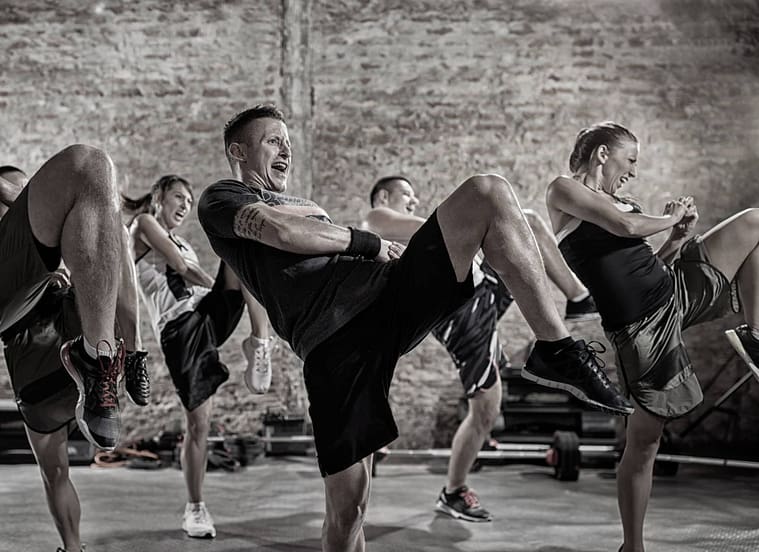
Yes. You do not need a martial arts background, and you do not need to be in shape first. Fitness is something MMA training gives you, not an entry requirement.
Source: Lucky Business, Standard License, via Shutterstock
Starting late is not a barrier either. Francis Ngannou told the UFC that he began training in "July 2013. I was curious." He was 26. Less than eight years later, he was the UFC heavyweight champion.
You are probably not aiming for a title, and you do not have to. As an Aikido instructor, I saw people in their 40s and 50s walk in as complete beginners and make remarkable progress. The ones who lasted started at their own pace and left their ego at the door.
If your goal is to compete for a living, that is a different road. Our guide on how to get into MMA professionally covers it.
How to Start MMA Training: 6 Steps
Step 1: Find the Right Gym
The gym matters more than anything you will buy. Look for one that teaches striking, wrestling, and jiu-jitsu, and that runs a separate class for beginners.
Then visit. Most gyms offer a free trial class, so try two or three before you sign anything. Watch for these:
From my own years of teaching, I can tell you the instructor and the training partners matter more than the building. Still deciding between arts? Read our comparison of kickboxing vs. MMA.
Step 2: Get the Basic Gear
You need very little for your first month. Many gyms lend gloves to beginners.
Our shop carries beginner gear.
Step 3: Learn the Fundamentals of Each Range
MMA has four ranges. A beginner's job is to become comfortable in each one, not to collect techniques.
The Four Ranges of MMA Compared
Where each one comes from, what to learn first, and the mistake most beginners make.
Range | Where It Comes From | What to Learn First | The Common Beginner Mistake |
|---|---|---|---|
Striking | Boxing, kickboxing, and Muay Thai | Stance, footwork, the jab and cross, and one kick | Throwing combinations before you can move your feet |
Wrestling | Freestyle and Greco-Roman wrestling, and judo | A balanced stance, the sprawl, and one takedown | Standing tall and reaching with your arms |
The Clinch | Muay Thai and wrestling | Head position, underhooks, and how to break away | Treating it as a rest instead of a fight for position |
Ground Fighting | Brazilian Jiu-Jitsu and wrestling | The main positions, and how to escape the bad ones | Hunting for submissions before you can hold a position |
My first striking seminar after years of Aikido was humbling. I had to relearn how to generate power while keeping my balance. Every beginner goes through some version of that, so do not let it put you off.
When you are ready for specific techniques, start with our guides to essential MMA techniques, MMA moves, and types of kicks. For the ground, see our beginner's guide to Brazilian Jiu-Jitsu.
Step 4: Build Your Fitness Steadily
New students usually train too hard, too soon. Then they get hurt or burn out, and they quit.
Firas Zahabi, who coached Georges St-Pierre, has the best rule I know. "I'm a big believer in consistency over intensity," he told Joe Rogan. "Intensity should be done once in a while." His test is simple: you should train, and wake up the next day feeling good.
In practice, that means two or three classes a week to begin with. Add a little running or skipping and some basic strength work on the other days. Sleep is part of training too.
For the detail, see our guides to strength training, sleep and recovery, and our MMA strength and conditioning program. Talk to your doctor before you start any new training program.
Step 5: Train on a Schedule and Track Your Progress
Pick your training days and protect them. Two classes every week for a year will take you much further than five a week for a month.
When my daughters trained Brazilian Jiu-Jitsu, I helped them keep training journals. It made them more aware of what they were studying, and they learned faster because of it.
Step 6: Start Sparring the Right Way
Sparring is where you find out what works. It is also where beginners get hurt, usually by going too hard too early.
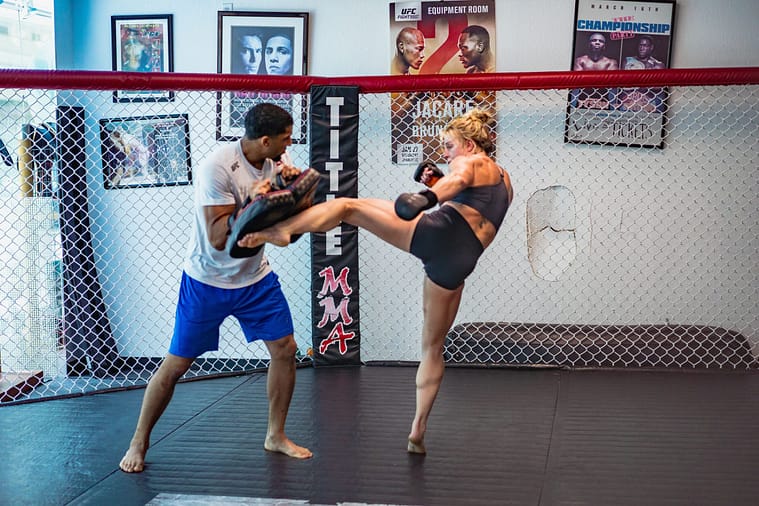
The UFC Performance Institute grades sparring in five levels. The first is called Learning, and its instructions are worth memorizing: "All speed, no power. Focus on movement, foot work and technique, not power." The next level adds a rule I wish every gym posted on the wall: "Do not make partner pay for being out of position."
Source: DUREN WILLIAMS, Pexels License, via Pexels
Start there, and stay there for months. Begin with drills where only one thing is allowed, such as jabs only, or escaping from the bottom. Add more as your control improves.
Take care on the ground as well. The same report found that grappling causes more training injuries than any other activity, even among UFC fighters. Its advice is to talk to your training partner, and to do the hard grappling early in a session, before you are tired.
What to Expect in Your First MMA Class
Most beginner classes follow the same pattern. You warm up, the coach teaches one or two techniques, you drill them with a partner, and you finish with conditioning. You will not be asked to spar on your first day.
Expect to feel clumsy. Everyone does. Many gyms also bow or shake hands before and after a round. Our guide to bowing in martial arts explains the custom.
Can You Learn MMA at Home?
Partly. You can build fitness, practice footwork, and drill strikes at home. What you cannot do alone is learn to deal with a person who is resisting you, and that is the heart of the sport.

Source: oneinchpunch, Standard License, via Shutterstock
What works at home:
What does not:
I have always practiced at home between classes, and it helps. But I have also had to help self-taught students unlearn habits that a coach would have caught in the first week. Use home training to support the gym, not to replace it.
How Long Does It Take to Learn MMA?
Expect about six months to feel at home with the basics, and about two years to become well-rounded. These are my own estimates from four decades around martial arts, not figures from a study. They assume two or three classes a week.
Earlier experience shortens the road. A wrestler, a boxer, or a jiu-jitsu player already owns one of the four ranges. So does anyone who simply turns up, week after week.
5 Mistakes to Avoid When You Learn MMA
1. Skipping the Fundamentals
Spinning kicks and flying submissions are fun to watch. Stance, footwork, and position are what you will use every round.
2. Neglecting Defense
Everyone wants to learn how to hit. Fewer want to learn how not to get hit. John Danaher, one of the most respected coaches in grappling, puts defense first: a good jiu-jitsu player "puts his or her primary effort into sound defensive structure before anything else."
3. Training With Your Ego
You will get tapped, taken down, and tagged by people smaller than you. That is the lesson, not an insult. Georges St-Pierre kept that attitude at the very top of the sport: "I keep the white-belt mentality that I can learn from anyone, anywhere, anytime."
4. Overtraining
More is not better. Pain that gets worse is a signal to stop, not a test of character. Our guide to injury prevention explains what to watch for.
5. Gym Hopping
Try several gyms before you choose one. After that, stay. Changing coaches every few months means starting over every few months.
Final Thoughts on Learning MMA
Learning MMA is simple to describe and hard to do. Find a good gym, turn up on schedule, learn the basics of every range, and spar with control.
The students who succeed are rarely the most gifted. They are the ones who are still training two years later. Be patient with yourself, and enjoy being a beginner, because that feeling never fully goes away.
For more, our 30 mixed martial arts tips pick up where this guide ends.
Have you taken your first class yet? What surprised you most, and what do you wish someone had told you beforehand? If you are still deciding, what is holding you back?

Frequently Asked Questions
How Do I Start MMA With No Experience?
Find a gym that teaches striking, wrestling, and jiu-jitsu and runs a beginner class. Take a free trial, and start with two or three classes a week. Focus on stance, movement, and the basic positions before anything advanced. You do not need to get in shape first.
Can I Learn MMA at Home?
You can learn part of it. Fitness, footwork, and striking on a bag can all be practiced at home. Takedowns, escapes, and timing need a partner who resists, and you need a coach to correct your mistakes. Treat home training as support for a gym, not a replacement.
How Long Does It Take to Learn MMA?
Expect about six months to feel comfortable with the basics, and about two years to become well-rounded, training two or three times a week. Earlier experience in wrestling, boxing, or jiu-jitsu shortens that. These are estimates from experience, and everyone progresses at a different rate.
Is 30 Too Old to Start MMA?
No. Francis Ngannou began training at 26 and became UFC heavyweight champion. Most people who start in their 30s, 40s, or 50s are training for fitness and skill, not a title. Start at your own pace, and allow more time to recover between sessions.
How Many Days a Week Should a Beginner Train MMA?
Two or three classes a week is enough to begin with. Coach Firas Zahabi's rule is consistency over intensity: you should wake up the day after training feeling good. Add a fourth session only when your body is recovering well.