Bowing in martial arts is a sign of respect, not of worship or submission. It tells your teacher and your partner that you are present, that you are grateful for the practice, and that you will train with control.
I have bowed onto a mat thousands of times. First as a teenager in Isshin Ryu Karate four decades ago, and later through years of Aikido. My teachers were Shihan Benjamin Galarpe on Guam, then Shihan Yoshimitsu Yamada, Shihan Donovan Waite, and Shidoin Jason Perna in the United States.
In the beginning, the bow felt like a formality. It took me years, including my time as a staff instructor at Old City Aikido in Philadelphia, to see that it is the first technique you learn and the last one you master.
Why Do Martial Artists Bow?
Ask five instructors and you will hear five answers. In my experience, they all come down to four things.
Jigoro Kano, the founder of judo, put it better than anyone. "Bowing is an expression of gratitude and respect. In effect you are thanking your opponent for giving you the opportunity to improve your technique."
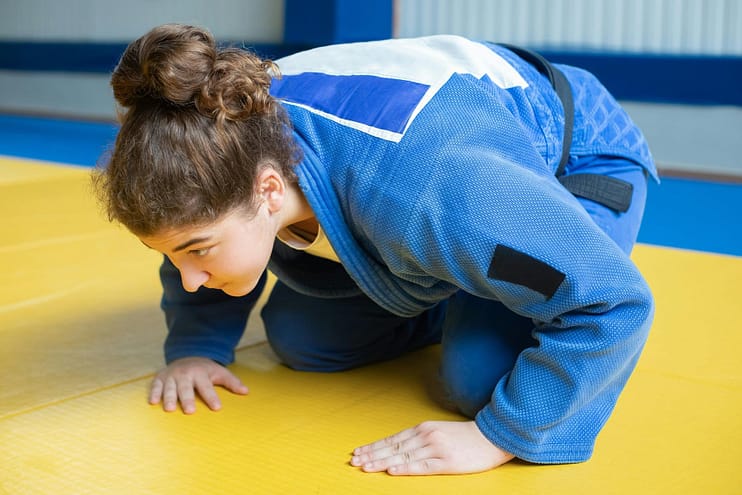
Source: Kampus Productions via pexels
Gichin Funakoshi, who brought karate to mainland Japan, made it the first of his twenty principles: "Never forget: karate begins with rei and ends with rei." Rei is the Japanese word for courtesy or respect, and in the dojo it means the bow.
Here is my own definition, after forty years. The bow is a promise. It says, "I will take care of you while we practice something dangerous." Everything else follows from that.
Where Does Bowing in Martial Arts Come From?
Bowing is far older than any martial art. It was everyday manners across East Asia long before anyone tied on a belt. The martial arts simply kept it.
In Japan, the formal version can be dated. Ogasawara Kiyomoto, whose family has taught samurai etiquette for more than thirty generations, explains: "My ancestor Ogasawara Nagakiyo founded the Ogasawara-ryū school in 1187. He instructed Minamoto no Yoritomo, the first shōgun of Japan, in etiquette, archery, and mounted archery."
The school says its etiquette "was taught to warriors across Japan as appropriate behaviour for samurai, and became the foundation for martial arts etiquette."
What surprised me is how practical it was. According to Ogasawara, moving correctly "also served as a means of defense against attack." A samurai watched the other man's hands during a bow, because the hands showed whether a sword could be drawn. Courtesy and caution were the same movement.
That idea survives in every dojo I have trained in. You bow, and you stay aware. For more on how these arts developed, see our history of martial arts.
Is Bowing a Sign of Weakness?
No. Many Western beginners read the bow as submission. It is the opposite.
The International Judo Federation describes it this way: "By bowing to our training partner, or our competing opponent, we mark the victory of human consciousness over our animal instinct." You are about to try to throw, strike, or choke this person. First, you show them you are in control of yourself.
When I taught Aikido, I noticed a pattern. Students who resisted the bow often struggled with ego on the mat. Those who embraced it tended to progress faster, because they stayed open to correction.
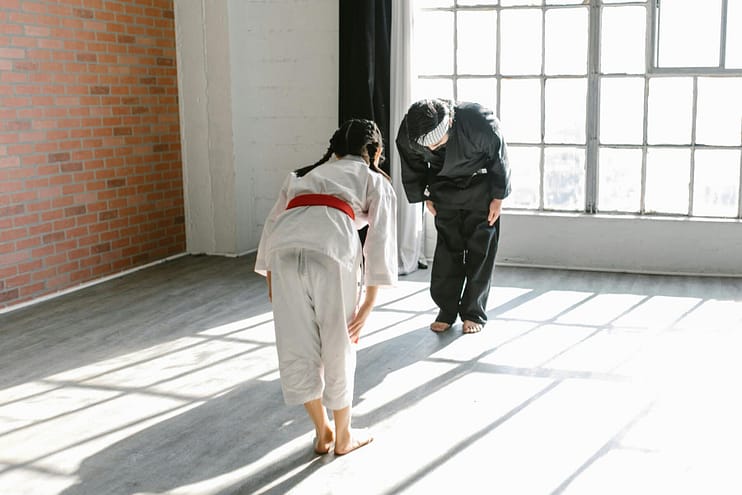
Source: RDNE Stock Project via pexels
You can see the same thing at the top of the sport. After Lyoto Machida knocked out Vitor Belfort at UFC 224, he stood over his fallen opponent and bowed. "I have a lot of respect for Vitor Belfort," he said afterward.
His father and teacher, Yoshizo Machida, had set that standard years earlier: "Every time Lyoto competes and gets another victory, he should leave the ring or the Octagon being more humble than when he walked in."
Types of Bows in Martial Arts
Every art has its own bow. The purpose is the same, but the form tells you where the art comes from. If you are still choosing a style, our guide to the types of martial arts compares them side by side.
Martial Arts Bows Compared
What each bow is called, how it is done, and when you will see it.
Art | What It Is Called | How It Is Done | When You Will See It |
|---|---|---|---|
Karate, Judo, and Aikido | Rei. The standing bow is ritsurei, the seated bow is zarei. | Bend forward from the waist with a straight back, or bow from a kneeling position | Entering the dojo, opening and closing class, and with every partner |
Kung Fu | Baoquan li, the fist-and-palm salute | Right fist against an open left palm, held in front of the chest | Greeting a teacher, and before and after a form or a match |
Taekwondo | Kyeong-rye | Stand at attention, then bow from the waist | To instructors, partners, and officials, before and after a match |
Muay Thai | The wai, and the wai kru before a fight | Palms pressed together with a slight bow of the head | Greeting a teacher, and in the ring before the first bell |
Brazilian Jiu-Jitsu | No single name | A short standing bow, a handshake, or a slap and fist bump | Stepping on the mat, lining up, and before each roll |
The Karate Bow, and the Bow in Judo and Aikido
Japanese arts use two bows. The standing bow, ritsurei, is the everyday one. In judo's official description, you stand with your back straight, then bend the upper body forward by approximately 30 degrees, letting your fingertips slide down toward your kneecaps.
The seated bow, zarei, opens and closes class. You lower the left knee to the floor first, then the right, and sit back on your heels. That kneeling position is called seiza. From there, you place both hands on the mat in front of your knees and bow forward.
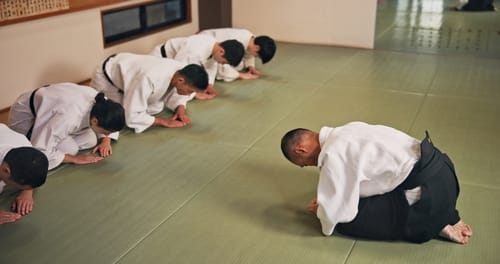
Source: PeopleImages, Standard License, via Shutterstock
A karate class usually opens with three bows. The Japan Karate Association lists them as a bow to the front, a bow to the instructor, and a bow to each other. In Aikido, we bowed to the front of the dojo, where a portrait of the founder hangs, and then to the teacher.
The Kung Fu Bow, or Fist-and-Palm Salute
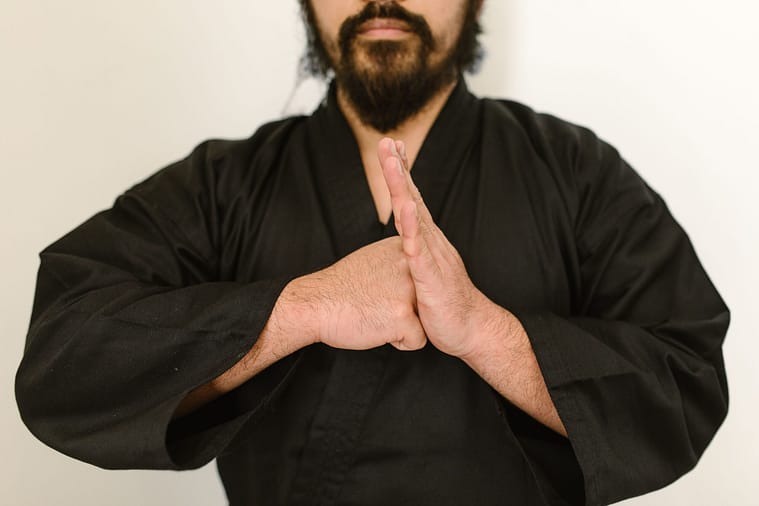
Chinese martial artists salute instead of bending at the waist. The gesture is called baoquan li. It is made with an open left hand placed against a closed right fist.
There is more than one explanation of what it means. In the one I find most useful, the fist stands for martial skill and the open hand for learning and courtesy. The open hand covers the fist. In other words, I can fight, and I choose restraint.
The Taekwondo Bow
In taekwondo the bow is called kyeong-rye. It follows the command cha-ryeot, which means attention. Olympic rules build it into every match: "Contestants bow to each other and to the officials before and after the match."
In class, students bow when they enter the training hall, to the instructor, and to each partner. If you have a child in taekwondo, this is usually the first thing they are taught.
The Wai in Muay Thai
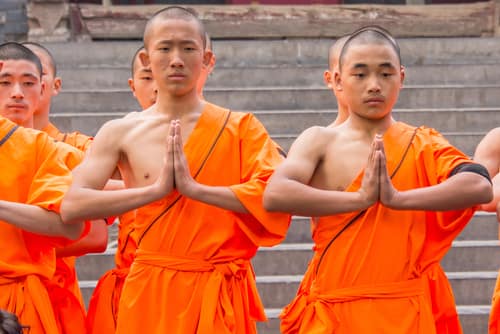
Thailand's greeting is the wai. You press your palms together and bow your head slightly. As one guide to Thai culture explains, "the depth of the bow and the level of the hands represents the level of respect." The younger or junior person offers it first.
Source: SIHASAKPRACHUM, Standard License, via Shutterstock
Before a fight, the wai becomes a ceremony. Rajadamnern Stadium in Bangkok translates wai kru as "Respect to the Teacher." Fighters use it to honor their trainers, their ancestors, and the art itself.
Bowing in Brazilian Jiu-Jitsu
Brazilian Jiu-Jitsu is the least formal of the group. Some academies bow onto the mat and line up by belt. Others simply shake hands. My two daughters trained BJJ for a year, and their school kept it short: a bow at the start and end of class, and a slap and fist bump before each roll.
The form was different from anything I grew up with. The meaning was not.
How to Bow Properly in the Dojo
Customs differ from school to school, so watch the senior students and copy them. These five habits will serve you anywhere.
The underlying idea is simple. As Ogasawara puts it, "The foundation of etiquette is to correct one's body." Good posture, the right movement, and the right frame of mind.
New to all of this? Our guide to the best martial arts for beginners will help you pick a first class.
When Do You Bow in a Class?
In a traditional Japanese dojo, you may bow dozens of times in one session. The usual moments are:
The bow at the edge of the mat matters most to me. At Old City Aikido, I reminded students that it honored O-Sensei and everyone who had trained there before us. It also did something practical. That short pause stopped people from walking onto the mat distracted, which is when accidents happen. Our guide to injury prevention covers the rest.
What counts is attention, not the number of bows. One mindful bow is worth more than twenty rushed ones.
What Do You Say When You Bow?
It depends on the art. In many karate schools, students say "osu" or "oss" as they bow to the instructor and to each other. In Aikido, we said "onegaishimasu" before practice, which is a polite request to train together, and "arigato gozaimashita" afterward, which means thank you.
Be careful with "osu." Karate researcher Jesse Enkamp traces it to the Imperial Japanese Navy's officer academy in the early 1900s, not to karate's birthplace in Okinawa. He quotes a Japanese linguist who calls it "a very rough masculine expression used mainly by young men toward other men."
So use it if your dojo does. If you visit a traditional school in Japan or Okinawa, listen first.
Does Bowing Conflict With Religion?
Some students and parents worry that bowing is a form of worship. In the martial arts I have practiced and taught, it is not. Nobody is praying to the mat or to a photograph. The bow is a greeting and a thank-you.
The question has even been tested in an American court. Three judo competitors in Washington State objected on religious grounds to the bows required before a match. In 2002, a federal judge ruled against them. The court accepted that the rules were adopted for legitimate purposes, including "preserving the etiquette and traditions of judo."
Your conscience is still your own. If any part of the bow troubles you, talk to the instructor before your first class. Good teachers will explain what each bow means in their school, and many will work with you.
Can the Bow Extend Beyond the Dojo?
It should. The physical bow may stay on the mat, but the habit behind it travels well.
Former students have told me the same thing over the years. The pause before the bow became a pause before a hard conversation at work. Acknowledging a partner became listening properly to a colleague. That is the point of the practice.
Georges St-Pierre has described the difference between a fighter and a martial artist in similar terms. A fighter trains for a fight. A martial artist, he said, trains "for a lifestyle." He credits his own outlook to his early years in Kyokushin karate.
If the quiet side of training interests you, read our guides to meditative martial arts and meditation for martial artists.
Why the Bow Still Matters
The martial arts bow takes two seconds and carries eight centuries of practice. It began as manners, became a way to stay alive, and ended up as the clearest sign of what separates a martial art from a fight.
For parents, the bow is often the most valuable thing a child takes home from class. Respect, focus, and self-control are learned by doing them, many times a week. Our guide to the best martial arts for girls looks at what else to expect.
For adults starting out, do not treat the bow as an empty ritual. Give it your full attention for two seconds. You will train better, and your partners will trust you sooner.
What has your experience with bowing been? Did it feel strange when you started, or has it always come naturally? Does your school bow a handful of times a class, or dozens? Customs vary more than most people realize, and the only way to know if yours is typical is to hear from people on other mats.
Join the conversation to share how your dojo does it and compare notes with others →

Frequently Asked Questions
Why Do Martial Artists Bow?
Martial artists bow to show respect, gratitude, and focus. The bow tells your teacher and your partner that you are present and that you will train with control. Jigoro Kano, the founder of judo, called it "an expression of gratitude and respect." It is not a sign of worship or submission.
Is Bowing in Martial Arts a Sin?
In martial arts, the bow is a greeting and a sign of respect, not an act of worship. Nobody is praying to the mat, the teacher, or a photograph. A U.S. federal court ruled in 2002 that judo's bowing rules serve to preserve the sport's etiquette and traditions. If the bow troubles your conscience, talk to the instructor before your first class.
What Do You Say When You Bow in Karate?
In many karate schools, students say "osu" or "oss" when they bow to the instructor or to a partner. Other schools bow in silence. The word comes from Japanese military and sports culture, not from Okinawa, so some traditional dojos do not use it. Follow the lead of the senior students.
What Is the Kung Fu Bow Called?
The kung fu bow is called baoquan li, the fist-and-palm salute. You hold your right fist against your open left palm in front of your chest. One common explanation is that the fist stands for martial skill and the open hand for courtesy. The open hand covering the fist shows restraint.
How Do You Bow Properly in a Dojo?
Come to a complete stop, keep your back straight, and bend forward from the waist. In judo, the standing bow is about 30 degrees. Pause briefly, then rise. Bow a little deeper to your instructor, and watch the senior students for the customs of your school.
Do You Bow in Brazilian Jiu-Jitsu?
It depends on the academy. Brazilian Jiu-Jitsu is the least formal of the bowing arts: some academies bow onto the mat and line up by belt, while others simply shake hands. Many schools bow at the start and end of class, then slap hands and bump fists before each roll.
Featured Image Source: Galdric PS, Standard License, via Shutterstock