I learned to punch with my thumb on top of my fist. That is an Isshin-ryu habit, picked up as a teenager in a traditional Okinawan karate dojo fifty years ago, and it still feels more natural to me than the horizontal fist most people throw. I went on to spend my adult life in Aikido, and when my daughters were old enough to train, I did the obvious thing and put them on my mat. They did not take to it. What they wanted was the Brazilian jiu-jitsu class all their friends were in, so that is where they went, and that is where they trained.
That taught me more about choosing a martial art than decades of training had. The art you pick matters less than the reason you keep showing up, and the room you show up to. So when someone asks me “taekwondo vs karate”, I hear a different question underneath it: what do you want this to do for you, or for your kid? Answer that and the choice gets easy. This article gives you what you need to answer it, from the rulebooks, the governing bodies, and the injury research, with my own experience where it earns a place. The one-line version: taekwondo is a kicking art shaped by Olympic sport, karate is a striking art shaped by Okinawan tradition and later by Japanese sport, and the two are not interchangeable. The differences show up in your body within a month.
The Short Answer
Choose taekwondo if you want to kick, you like the idea of an Olympic sport with electronic scoring and a clear competition path, or you have a child who needs to burn energy and learn to move. Choose karate if you want hands as well as feet, forms with deep roots, contact rules that allow punches to the head, and a tradition that puts etiquette and self-control ahead of medals.
Choose neither on the strength of a style name. In 2026 you can find a soft, trophy-driven taekwondo school and a hard, sparring-heavy one in the same town, and the same is true of karate. I will come back to how to tell them apart. First, where each art came from, because the history explains most of the differences people argue about.
Where Each Art Comes From
Karate was systematized in Okinawa in the 17th century and arrived in mainland Japan in the 1920s, according to Britannica. The man who carried it there was Gichin Funakoshi, born in 1868, who demonstrated Okinawan karate at a government-sponsored exhibition in Tokyo in the spring of 1922 and stayed to teach. His students named his method Shotokan, “the house of Shoto”, after his pen name. In 1929 he changed the written characters for karate from “Chinese hand” to “empty hand”, a quiet declaration that the art now belonged to Japan.
Karate was never one thing. Shotokan grew in Tokyo. Back in Okinawa, Tatsuo Shimabuku blended Shorin-ryu and Goju-ryu into Isshin-ryu in the late 1940s and taught it to American servicemen, which is how it reached the United States and, eventually, a dojo near me. Mas Oyama put up his first sign in 1954 and built full-contact Kyokushin through the 1960s. The World Karate Federation traces itself to a world union founded in Tokyo on October 10, 1970, and took its current name in 1992. You will read that karate has “four major styles”. No governing body says so. It has dozens, and the one on the door of your local school matters more than the family tree.
Taekwondo is younger and more centrally organized. Britannica describes it as a Korean art based on the older Korean practice of taekkyon and on karate, which is the plain truth: the Korean masters who opened the first schools, the kwans, after 1945 had mostly learned karate in Japan. The name taekwondo was adopted on April 11, 1955. General Choi Hong Hi is usually credited with proposing it and with founding the first national association, though historians writing in the Korea Journal note that the record is contested and that Choi was expelled from that association in 1965. He founded the International Taekwon-Do Federation in 1966. The Kukkiwon, the world headquarters for the other, larger branch, opened in Seoul on November 30, 1972, and World Taekwondo was formed there on May 28, 1973.
That split matters when you walk into a school. A World Taekwondo (Kukkiwon) dojang teaches Taegeuk forms and the Olympic sparring style. An ITF school teaches different patterns, allows punches to the head in sparring, and scores spinning and flying kicks more generously. Both are taekwondo. They do not feel the same.
Hands or Feet? Read the Rulebooks
The fastest way to understand the taekwondo vs karate difference is to read what each sport lets you score with. Rules shape habits, and habits shape the art.
Under the World Taekwondo rules in force for 2026, the only hand technique allowed is a straight punch to the body protector, worth one point. A kick to the body is worth two, a kick to the head three, and a turning kick doubles those to four and six. Grabbing or pushing your opponent costs you a penalty. Hits are registered by sensors in the chest and head protectors and in the socks. A fighter trained under those rules learns to kick fast, high, and often, with the hands held low because nobody is punching at the head.
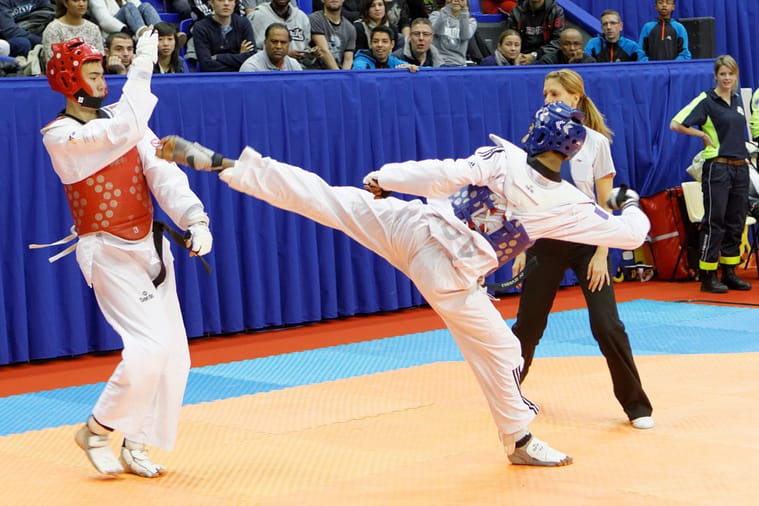
Source: Pierre-Yves Beaudouin, CC BY-SA 4.0 via Wikimedia Commons
Under the WKF kumite rules for 2026, a punch or strike to the head or body scores one point, a kick to the body two, and a kick to the head three. Foot sweeps and one-handed throws are legal, and taking an opponent down and following with a strike scores the maximum. Techniques to the head are controlled, stopped at the skin or a few centimeters short. A karateka trained under those rules learns to close distance with the hands, time a single committed technique, and keep the guard up.
My own karate sat outside both sport rulebooks. Traditional Isshin-ryu kicks are aimed almost entirely at the legs and groin, delivered with a snapping motion, and rarely rise above the belt. Blocks are made with the muscle of the forearm rather than the bone, and the punch is vertical, thumb on top, because Shimabuku believed it made the wrist stronger. When I watch Olympic taekwondo, the head-height spinning kicks look like a different sport to me, because they are. Neither version is wrong. One was built for scoring under lights; the other was built for a short Okinawan man who did not plan to kick anyone in the face.
Three Rulebooks, One Glance
What each sport lets you score with, under the rules in force for 2026.
Rule | World Taekwondo (Olympic) | WKF Karate | ITF Taekwondo |
|---|---|---|---|
Punches to the head | Not allowed | Allowed, 1 point | Allowed, 1 point |
Kick to the head | 3 points, 6 for a turning kick | 3 points | 2 points, up to 5 for flying and spinning kicks |
Grabbing, sweeps, throws | Grabbing and pushing penalized | Sweeps and one-hand throws allowed | Not scored |
Scoring | Electronic sensors in the protectors and socks | Judges | Judges |
Senior bout | Three rounds of two minutes | Three minutes | Varies by organization |
Forms | 17 Kukkiwon poomsae | Varies by style | 24 patterns |
Olympic status | Medal sport since 2000, on the Los Angeles 2028 program | Tokyo 2020 only | Not Olympic |
Forms: Kata, Poomsae, and Patterns
Every one of these arts drills solo forms, and the forms tell you what the founders valued.
Kukkiwon taekwondo has exactly 17 poomsae: the eight Taegeuk forms for colored belts, then nine black-belt forms from Koryo to Ilyeo. ITF taekwondo has 24 patterns, one for each hour of the day, by its founder’s design. Karate has no single count because karate has no single curriculum. Shotokan organizations list 26 or 27 kata depending on how they count the beginner forms; Isshin-ryu has eight empty-hand kata plus weapons forms.
I spent a lot of teenage evenings on Seisan and Naihanchi. Fifty years on I could not walk you through either of them, but I can tell you what forms are for from the inside. They are not a dance and they are not fighting. They are a way to drill structure, breathing, and transitions until your body stops asking permission. Taekwondo’s poomsae do the same job with a different vocabulary, more kicks and higher stances. If you enjoy that kind of solitary, repetitive, almost meditative work, both arts will reward you. If you hate it, karate will make you do more of it, especially in a traditional school.
What the Olympics Did to Each Art
Taekwondo was a demonstration sport in Seoul in 1988 and Barcelona in 1992 and became a full medal sport at Sydney 2000. It has been on every Games since, and the IOC confirmed it for Los Angeles 2028. Karate made one Olympic appearance, at Tokyo 2020, and was not selected for Los Angeles. The Brisbane 2032 program had not been published when this was written.
The Games made household names on both sides. Jade Jones of Great Britain took taekwondo gold at London 2012 and again at Rio 2016. When karate finally got its turn, Sandra Sánchez of Spain won the sport’s first Olympic medal in women’s kata and Ryo Kiyuna of Japan took the men’s, both without striking an opponent, which tells you how much karate still values form.
That history explains the biggest practical difference between the two arts today. Olympic status gave taekwondo a single worldwide ruleset, electronic scoring, national funding, and a clear ladder from a child’s first class to a national team. It also pushed competition taekwondo toward what scores: fast, high, turning kicks, thrown from an upright stance with the hands down. Karate kept its variety and its tradition, and paid for it with a fragmented sport side.
I have watched taekwondo at the Olympics, not every Games but enough, and I admire the athleticism without wanting to fight that way. The sensors reward touch, not damage. That is not a criticism of the athletes. It is a reminder that a sport rulebook is a filter, and if you train for the sport you will become what the filter rewards.
Which Hurts More? What the Injury Studies Say
Neither art is dangerous by the standards of football or rugby, but they break people in different places.
A review of fourteen taekwondo studies found an average of 79 injuries per 1,000 athlete-exposures in competition, most of them minor contusions to the lower limb. A later review of elite competitors found that the turning kick was involved in about half of all injuries, and that head injury and concussion rates were higher than in soccer or American football. A 2017 review put concussions at roughly 13 per 1,000 athlete-exposures in male competitors.
For karate, a 2020 review of 28 studies found 88 injuries per 1,000 athlete-exposures, with the head and neck the most common site, mostly bruises and cuts. A 2023 study of more than 2,400 WKF-rules fights found 47 injuries per 1,000 exposures, again led by the head, with senior men at the highest risk.
Read those together and the pattern is exactly what the rulebooks predict. Taekwondo hurts legs, because legs are the weapons and the targets. Karate hurts faces, because punches to the head are legal and control fails. The raw numbers are not directly comparable, because the studies define exposure differently, so do not let anyone tell you one art is “twice as safe” from these figures. From a strength and conditioning point of view, a taekwondo student needs hip, knee, and ankle work from day one. A karate student needs to take head contact seriously from the first sparring session, in equipment and in how the school manages it.
What Each Builds in Your Body
The research on fitness is thinner than the research on injuries, but it points the same direction for both arts: they work, and they work on more than muscle.
A one-year school karate program in five European countries, tested in a randomized trial of 721 children aged seven and eight, produced small but real gains in cardiorespiratory fitness, balance, behavior, and academic results. In adults with an average age of 70, five months of karate improved reaction time, stress tolerance, and divided attention where general fitness training did not.
Taekwondo has a matching set. Three months of daily taekwondo improved balance in children with developmental coordination disorder. Sixteen weeks of once-a-week classes lowered tension and depression scores and raised sociability in a pilot with children from multicultural families. In older women, sixteen weeks of taekwondo matched a multicomponent exercise program on strength and flexibility and beat it on some balance measures.
My reading of that evidence, after years of testing training methods on myself, is that the specific benefits follow the specific movements. Taekwondo’s high kicks demand and build hip mobility and single-leg balance in a way nothing else in a gym does. Karate’s stances and hand work build the legs isometrically and teach you to generate force from the floor. Both will get a sedentary adult fitter. Neither will make you strong the way a barbell does, and the best practitioners I know lift as well. If strength is your goal, read our guide to strength training for martial arts alongside this one.
Self-Defense, Honestly
Every taekwondo vs karate article on the internet has an opinion about “the street”. Here is what can actually be said.
World Taekwondo rules ban grabbing and pushing and allow no hand strikes to the head. WKF karate allows head punches, sweeps, and limited throws. Neither sport scores anything that happens on the ground. Both, in Britannica’s words, stop their blows short of contact in sparring. Those are facts about the sports. There is no peer-reviewed evidence on self-defense outcomes for either art, and anyone who claims there is has not looked.
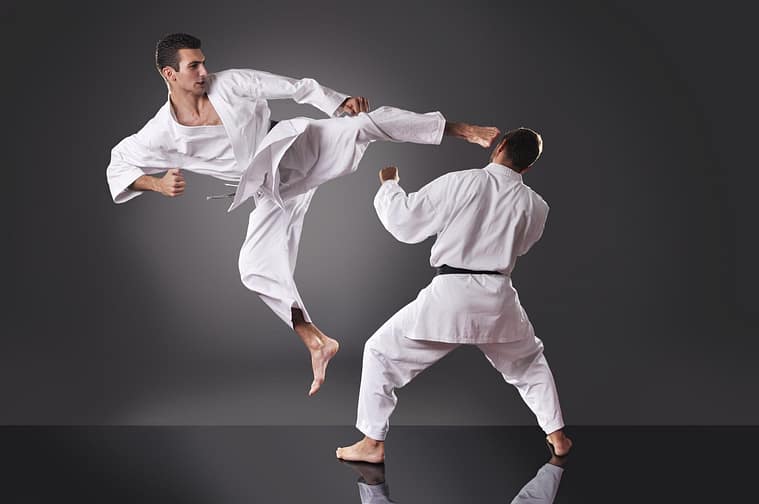
Source: cirkoglu via Shutterstock.com
Funakoshi’s second precept, as his students still publish it, is “There is no first attack in karate.” My Isshin-ryu teachers taught the same idea without the Japanese: you train so you never have to use it, and if you do, you finish it. Neither art was designed to start fights, and neither sport was designed to end them.
So here is my opinion, labeled as such. Rules build reflexes. If you spend ten years learning not to punch a head, you will not punch a head when it counts, and if you spend ten years pulling your strikes, you will pull them. A karate school that spars with contact and a taekwondo school that trains ITF-style with hands to the head both produce people who can protect themselves. A point-fighting school of either art produces people who can win point fights. Ask to watch a sparring class before you sign anything. If you are choosing an art mainly for protection, our guide to the best martial arts for self-defense ranks the options by the threat you are preparing for.
Choosing for a Child
This is the question most people searching “taekwondo vs karate” are really asking, and I got it wrong myself. I assumed my daughters would want my art. They tried Aikido, did not take to it, and chose Brazilian jiu-jitsu; they trained, attending classes plus seminars. Their friends turned out to be a better reason than fathers. Once they had chosen, the things I judged that school by are the same ones I would apply to a dojang or a dojo.
First, the instructor. Watch a class. Does the teacher correct technique, or run a kickboxing-cardio session with belts? Do the kids bow, line up, and listen, or is it a birthday party? Second, the contact policy. A school that never spars teaches a dance; a school that lets eight-year-olds hit each other in the head teaches a trip to the ER. You want the middle. Third, the belt economics. Both arts have schools that test every two months for a fee. Kukkiwon’s own rules say a child can hold a junior black belt, a poom, before age 15, and the WKF asks for a minimum of three years’ training and age 15 for a first dan, but the time to a colored belt is entirely up to the school. If every child in the lobby is a black belt by ten, that tells you something.
Between the two arts specifically, taekwondo tends to suit children who need to move and who like clear goals, because the sport side is structured, the kicking is fun, and the Olympic path is real even if your child never takes it. Karate tends to suit children who respond to ritual and precision, because even in 2026 a traditional dojo spends real time on etiquette, kata, and standing still. The research says both improve fitness, balance, and behavior. The school decides whether that promise is kept.
Choosing as an Adult
Adults have the easier decision, because adults know what they want.
If you want to kick, taekwondo. Nothing else will take your legs where Olympic taekwondo takes them, and our guide to the types of kicks in martial arts shows how many of them came from or were perfected in Korea. If you want hands, forms, and a tradition you can follow back three centuries, karate, and probably a Shotokan, Goju-ryu, or Okinawan school rather than a sport club. If you want full contact, Kyokushin karate or an ITF taekwondo school, with the understanding that both will hurt. If you want to compete internationally, World Taekwondo has the clearest path. If you want fitness and stress relief, either, and pick by schedule and instructor.
If you are thinking about MMA, know that both arts have produced elite fighters, and that none of them fought with only their first art. Anthony Pettis holds a third-degree black belt in taekwondo, and the kick he ran off the cage to drop Benson Henderson at WEC 53 in December 2010 is still the most taekwondo thing ever done in a cage. I watched it live and came out of my chair. Anderson Silva, a fifth-dan in taekwondo, finished Vitor Belfort with a front kick to the face at UFC 126, another one I saw as it happened. Rose Namajunas earned a junior black belt in taekwondo by nine before she ever wore UFC gold.
Karate’s side of the ledger is just as deep. Lyoto Machida trained Shotokan from the age of three under his father and knocked out Rashad Evans for the UFC light heavyweight title at UFC 98 in 2009 with a stance and timing straight out of a dojo. Georges St-Pierre started Kyokushin at seven and was a second-dan by twelve. Stephen Thompson holds a fifth-degree black belt in kempo karate and went 57-0 as a kickboxer before the UFC. The lesson is not that one art wins. It is that a base in either art gives you distance, timing, and a kicking or striking weapon that pure boxers and wrestlers have to learn late, and that you will need grappling on top of it. Our comparison of kickboxing vs MMA covers that gap from the other side.
My Final Word
I have trained Okinawan karate and I have spent most of my adult life in Aikido, a Japanese art that has nothing to do with either of these. I have watched taekwondo at the Olympics and I watched karate’s one appearance in Tokyo. If I were starting again at fifteen, I would pick the school with the teacher I respected most and the sparring policy I trusted, and I would not care which name was on the sign. If you are weighing taekwondo vs karate right now, that is my advice to you as well. The art will shape you. The school will decide how.
Did you pick karate or taekwondo, and would you pick the same one again? Compare notes with other karateka and taekwondoin at the open mat and find out what drove their decision →

Frequently Asked Questions
Is Taekwondo Better Than Karate?
Neither is better in general. Taekwondo is the stronger choice if you want to kick, compete in an Olympic sport, or give a child a structured path. Karate is the stronger choice if you want hand techniques, head-contact sparring, and traditional forms. The quality of the school matters more than the name of the art.
What Is the Difference Between Karate and Taekwondo in One Sentence?
Karate is an Okinawan and Japanese striking art that uses hands and feet about equally and allows punches to the head in sport, while taekwondo is a Korean art built around fast, high kicks whose Olympic version scores no hand strikes to the head at all. Both drill solo forms and both stop blows short of contact in sparring.
Which Is Better for Kids, Karate or Taekwondo?
Both improve fitness, balance, and behavior in children, according to randomized trials of school programs. Taekwondo suits kids who need to move and like clear competitive goals. Karate suits kids who respond to ritual and precision. Visit the school, watch a sparring class, and ask how long colored belts take before you decide.
Can You Punch to the Head in Taekwondo?
Not under World Taekwondo rules, the Olympic version, where the only hand technique is a straight punch to the body protector. ITF taekwondo does allow hand attacks to the head in sparring. WKF karate allows controlled punches to the head and scores them one point.
Featured Image Source: Benjamin Bellamy, CC BY-SA 4.0, via Wikimedia Commons (cropped and enhanced)